Wednesday, October 2, 2013

Famous in the Netherlands?

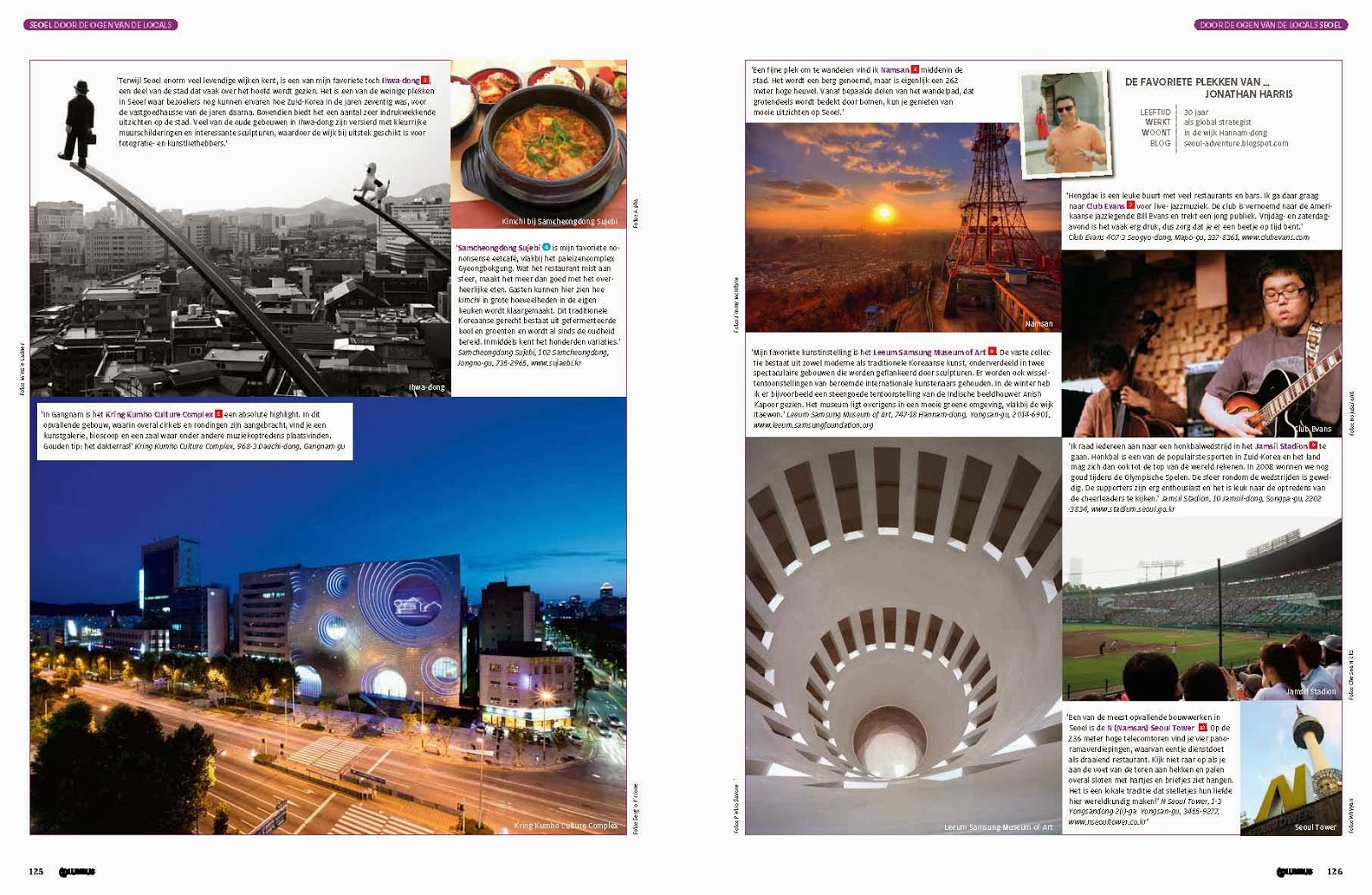
I recently did an interview for Columbus, the leading Dutch travel magazine.  The article is about the highlights of Seoul, according to the "locals".  By locals I'm pretty sure they mean "expats", but whatever ... I'm semi-famous!  You might see me on the newsstands of the Netherlands or Belgium, or if you fly KLM Business Class.  Which I'm sure you all do :)

I described to the editor a bunch of places I enjoy in Seoul, and she picked Namsan, the Leeum (Samsung Museum of Art), Jamsil Stadium for baseball, and Club Evans in Hongdae for cool jazz music.  I even learned about some new places that I need to check out!


Friday, September 13, 2013

First Korean Wedding!

It was only a matter of time before I would be invited to my first Korean wedding here in Korea.  In this country, weddings are a big deal – the Koreans I know seem to be attending weddings all of the time. Granted, I have missed several weddings in the USA since moving to Korea and had I stayed in my home country I probably would have been wedding-hopping on many weekends as well. However, Koreans take this to a higher level...their weddings are known for having a ton of attendees.

The newly married, Hyungjun and Min Ji
Hence I was excited to see what all the fuss was about when I received an invite to my first Korean wedding from my friend Hyungjun, who I had worked with previously in the US. Hyungjun had introduced me to his fiance in January at a BBQ restaurant and she seemed like a great gal, so I was excited for my friend. I'm sure Hyungjun was even more excited, as he and his fiance have lived apart for two years: she in California and he in Korea where he has been completing his compulsory two-year military service.

I asked a couple other Korean friends what to expect, and this is what I heard:

  • The ceremony will be very quick, much quicker than American weddings
  • Make sure to bring money in an envelope, which will be collected at the wedding hall. Give 50,000 Korean won for regular weddings, and 100,000 won for closer friends.
  • Make sure to get into the photo at the end to show you were there!

A feature not seen at American weddings: bowing to the parents
Last Saturday afternoon, I put on a suit and hailed a taxi in my neighborhood.  When the driver dropped me off at a nondescript office building in Gangnam, I thought maybe I was at the wrong place. But when I walked inside I saw several Koreans of all ages in suits and found a video display with my friend's name on it in Korean text. He was the 5:00 wedding that day...and there were also weddings at 4pm and 6pm. This wedding hall was like an assembly line!

Up a couple floors and I found Hyungjun in a tuxedo and wearing white gloves. I also recognized his parents, who I had met when I visited Hyungjun's hometown during the spring. They greeted me very warmly and I immediately felt welcome, despite being the only foreigner in this wedding hall.

Not knowing anyone else there, I didn't have anyone to coach me through what to do, which was a little worrying. I managed to find a desk where I signed my name into a book, and provided my envelope of money (for reference: they provide these at the wedding hall). I stood around and did some people-watching, took some photos, and wrote a little congratulatory note for the soon-to-be married. Men were mostly in suits and women in regular dresses, much like American weddings, except many of the female family members were dressed in colorful traditional hanbok outfits.

Family photo after the wedding
A couple minutes before 5pm, the 4pm wedding was chased out of the wedding hall and we were summoned in. I took a place in the back and tried not to block the view of too many Koreans. First, the mothers walked in and did a bowing ceremony at the front, then Hyungjun, and finally the bride with her father. No best man, maid of honor, or other wedding entourage like in the US. The parents sat off on both sides of the stage in comfy-looking chairs (groom's on left, bride's on right) and a pianist sat at a piano in the back.

The minister at the front, if he could be called that (this ceremony seemed entirely secular) gave a long speech to lead off the wedding. With the little Korean I know, I gather he was talking about the history of the couple and maybe giving some advice on the meaning of marriage, though I'm not really sure. Not too many people in the back seemed to care about this man's words either...they were mostly 20-somethings who seemed more interested in chatting and catching up with each other. There seemed to be no shame with coming and going from the ceremony, nor with talking at a low volume. Definitely more casual than what I am used to. A photographer was walking around snapping a ton of photos, and another young lady kept adjusting the bride's long dress to make sure it looked perfect.

After the long speech, which lasted about 15 minutes, the bride and groom walked towards the bride's parents and the newly married gave a full bow to the parents. Hyungjun got down on his knees and put his head all the way to the ground. His bride was permitted to remain standing – if she knelt down, how would they have fixed her dress for the photographs! – and bow at 90 degrees. Then hugs and handshakes were exchanged, and the same process was repeated on the other side of the stage with Hyungjun's parents. Finally, the couple was declared husband and wife, I think (or something to that effect in Korean).  Total time: 25 minutes.

Now the photo time, and this is where my stress bells went off. I had been told, "Make sure you get in the photo," but no one had told me that there would be multiple photos! The first photo had many older people in it and this clearly looked like the family photo. The stage cleared and a bunch of younger-looking people crashed the stage for the second photo, which I thought must be the friends' photo. I smiled and walked off the stage, but then a third group assembled on stage for a photo, and I got concerned. The guys on stage seemed closer to Hyungjun than the group I wandered on stage with. When I told my Korean teacher about this a couple days after, she laughed out loud and told me that I had crashed the "distant relatives" photo!! My, will I look like a goofy foreigner in that one!

At 5:50pm, everyone was chased out of the hall and we wandered upstairs for food. We were served galbitang, a beef short-rib stew, and a wide variety of Korean side dishes appeared on the table. Wedding hall staff flew around the room throwing food on tables and everyone was eating very quickly. Seating was unassigned so I stumbled down at a table with Hyungjun's middle school friends. I was able to communicate with them in broken Korean and a little English, and they were amused with the foreigner trying all of the Korean side dishes (most of which I have already eaten in Korea). This group clearly does not get to see each other much so they were busy catching up. I sat and ate quietly.  By about 6:45, food time was over, the wedding party had made their way around the room to shake hands and take pictures, and we were done – time to go home! No dancing, no speeches, nothing more.

Clearly I had been impressed by the speed of all this and the assembly-line manner we were whisked around the wedding hall. It all was very much fitting with Korea's palli palli ("hurry up!") culture. Now I understand how some Koreans can attend two weddings in one day! The parent worship was impressive and the gift-giving far simpler than trying to decide what someone would like off of his wedding registry. However, the whole ceremony felt rather informal compared with American weddings, and given the amount of importance that Koreans place upon traditional marriage I am a little surprised that they don't take more time to savor these events.

At least next Korean wedding I will be in the correct photo ^_^

Thursday, August 8, 2013

Summer Blues

Today I celebrate my one year anniversary in Korea!!  Time flies, though at my age this might now start happening during both good times and bad.

Now that I'm gearing up for my second trip around the sun from this part of the world, the inevitable comparisons with life 12 months ago crop up in my mind.  Indeed, a lot has changed in the past year!  I started a new job, made dozens of new friends and acquaintances, and even speak a little Korean (not enough to be fully conversational ... yet).  Life here isn't quite as fresh and strange as it was when I started, but it remains far from familiar and I still learn new aspects of life and the culture here all of the time.

Koreans like to ask me what I think about life in their country.  I tell them that I like the people, I like the convenient lifestyle, I like Korean BBQ.  But one thing I don't like is the weather.  It is a mess.  In winter, I wrote about how cold the weather was, almost as bad as where I grew up (Milwaukee, USA).  Spring was okay, but relatively brief – just April and May more or less.  By June, temps were already above 30C and the heat only gave way for the legendary Korean 장마 (jangma) ... rainy season!!

About to tackle whitewater rafting near Inje (Gangwon Province)

July was an absolutely dreadful month to be here.  Pretty much every day was overcast (I think I counted 3 sunny days) with a guaranteed chance of rain at some point in the day, if not a complete day of monsoon showers.  Not carrying an umbrella was just taunting Mother Nature to unleash her moisture.  Just about everyone I know here owns at least half-a-dozen umbrellas, the inevitable consequence of being caught outside on the one decent-looking day where just maybe you didn't think you needed to carry one...wrong!...and purchasing yet another rain contraption to add to your collection.  Thankfully an umbrella can be found just about anywhere within a 1-block radius in Seoul (I did mention I like Korean convenience).

And it was the longest Korean monsoon season on record this year – 49 days! – finally abating officially on Sunday.  But once the clouds lifted the heat really cranked up in the city ... it's like a jungle now.  Just walking to the bus stop yesterday morning caused me to break a sweat.  We already had the hottest June on record in Seoul in 2013 and I'm wondering if August will be the same.  Walking into the office isn't much better.  Samsung is keeping its thermostats set to 28C this summer due to a power shortage (foreigners to Korean government: "Build some power plants!") and stepping into most conference rooms at Samsung now is comparable to entering a sauna.  If the weather is anything like last year, more rain and typhoons (!) are just around the corner.

Covered in paint after running the Color Me Rad 5K with my foreign Samsung colleagues

But Korea is a land of extremes, so I guess the weather here just fits the national psyche.  Emotional people, spicy food, brutish work and study schedules, the highest consumption of cigarettes and alcohol in Asia ... Koreans and their culture are like their weather.

But thankfully, even during rainy season I was able to do some fun things here like go rafting in beautiful Gangwon Province and run the Color Me Rad 5K, a phenomenon that has crossed oceans!  That said, I look forward to September ... and the day when I can again type in this blog without air conditioning.

Sunday, July 7, 2013

South Korea Travels

Last weekend I returned to the US for a long weekend to attend a wedding, and while crammed in a sardine can of an airplane for a pair of 13-hour flights (thank you American Airlines...not) I had a chance to reflect on the first half of 2013.

I am not one to make New Year's resolutions typically, but 2013 was an exceptional year.  As the ball was dropping in New York City / Boshingak bell was being rung in Seoul, I had decided that I wanted to see more of this country that I now inhabit.  In my first 8 months here I had been a very bad Korean tourist, having done little outside the capital city (besides where Samsung sent us during our orientation).  As Seoul is absolutely massive there are always things to find here, and I had set my eye on other travel around Asia, taking two holiday trips to China and three to Japan.  But I didn't want to one day leave here without seeing the rest of my adopted country.  South Korea isn't that big, after all (it's about the size of the US state of Virginia), and being rather low on Samsung vacation days made in-country weekend travel far more appealing.

Wintertime was cold and bleak in this country, and besides a couple ski day trips east of Seoul I didn't escape the city except on an airplane.  Once a glimmer of mild spring weather kicked in, I started booking my weekends.  Here is a recap:

March 24: Daejeon
One of my college roommates was in town, as he is married to a Korean lady nowadays. Turns out that her brother is the star player on the Daejeon team in Korea's professional volleyball league, so she invited me to join my old roommate and her family for a day trip to Daejeon to watch the team play.  Daejeon is about a two-hour drive south of Seoul and despite being the 5th largest city in Korea is known for absolutely nothing (when I asked my Korean hosts this question, they paused for a long moment, struggling for an answer, and finally blurted "...the Expo??").  The drive through town past a series of monochromatic concrete buildings confirmed Daejeon's drabness.

Prime seats for Korean professional volleyball

However, Daejeon has a fantastic volleyball team, sponsored by Samsung of course, and I had prime seats in the "VIP" section for game 1 of the Korean mens' professional volleyball championship series!  Volleyball in Korea, I discovered, was awesome.  Cheerleaders, chants, special cheering sections for the star players (one of which pulled off this amazingly coordinated card trick during a timeout), pyrotechnics, and insanely dedicated fans who did nothing but yell for two hours straight.  Closest thing in America to this atmosphere would be a high-school basketball gymnasium.  I loved it.  The Daejeon Samsung Bluefangs won and I had discovered a new favorite professional sport in Korea.  My Korean hosts were super kind as well and I really appreciated their generosity.

April 4: Daegu
This trip was quasi-work-related – a couple colleagues and I were heading to Daegu for its annual Green Energy Expo.  Never mind that Samsung has shut down its renewable energy development business completely, or that most of the presentations would be given in Korean.  So it was a bit of boondoggle, but we had nothing else to do really as we were on "beach week" between projects at work.

Daegu "EXCO", covered in solar panels

Highlights included my first ride on the high-speed KTX train (very nice and fast) and a tour of the earth-friendly features of the Daegu convention center building (the whole roof is covered with solar panels).  Daegu was similarly drab as Daejeon, but the people were very friendly.  On said tour I had my first truly weird foreigner experience in Korea with a middle-aged woman from Ulsan who was convinced that I resembled a Hollywood movie star (I don't receive Tom Hanks comparisons in the States). I allowed some photographs and am now probably on her Facebook page.  Also at the expo the Daegu chamber of commerce had set up a free medical checkup station, only for foreigners.  I stood for a body fat scan and discovered that I am considered "obese" by Korean standards.  In fact, a nurse called me "obese" to my face and drew a stick figure of a fat man to communicate my test results.  There's a first time for everything...

April 12-13: Busan
This was also courtesy of another work field-trip boondoggle to the Samsung Heavy Industries shipyard on Geoje Island.  A massive facility and very impressive.  Geoje Island is along the southeastern coast near Busan, Korea's 2nd city, so a colleague and I found a hotel room and stayed over in the city for Friday night.  I really liked Busan.  The air was cleaner than Seoul and the vibe was a lot more relaxed.  Also Busan has a very nice beach, the most popular in Korea I am told, and a defined skyline unlike Seoul.  My colleague and I ate at a nice sashimi place along the beach for dinner, and though Korean sashimi is dull compared with its Japanese counterpart my colleague and I had a grand time mixing our fish with the many side dishes and, of course, soju.  The nightlife scene near the beach is fun too.  I would definitely revisit Busan.

Haeundae Beach.  This place will be mobbed during the summer months.

May 4: DMZ Tour
I covered this trip to the border between the two Koreas in another post.  I definitely want to revisit to see the Joint Security Area.

May 11-12: Seonyudo Island (Jeollabuk Province)
I booked this trip rather last minute with a travel group that specializes in providing adventures to Korea's many English-language teachers.  While I felt rather out of place as someone who is building an actual career in this country (and not just here on a one-year joy stint), I was glad to tag along to see another part of the country which I hadn't seen before...the "West Sea" between Korea and China (also known as the Yellow Sea).


In Seoul I boarded a 3-hour bus for Gunsan, an industrial town on the western coast, then rode a 45-minute ferry to Seonyudo Island (which is also the name of an island closer to Seoul).  We rented bicycles and rode around on a beautiful mild spring day.  The atmosphere was peaceful around the little fishing villages that dotted the island.  There was also a beach here and we were the only foreigners in the area, the others were mostly Korean families and groups of Korean middle-aged men and women who had come to get drunk together on the beach while watching the sunset.  We shot off bottle rockets and went searching for clams.  A nice weekend escape from the city life.

May 17-19: Hwaeomsa Temple and Hadong Green Tea Festival
May 17 was Buddha's Birthday on the lunar calendar this year, which fell very conveniently on a Friday so we received a long weekend!  A group of Samsung foreigners had organized a temple stay in the Jiri mountains on the southern part of the peninsula.  It was a beautiful area – big lush green mountains and winding roads through the valleys.  I was reminded a bit of my trip to the Alps a long time ago.  Getting to this beautiful landscape was a nightmare though.  Traffic in Korea is legendarily bad on holidays and we spent 6.5 hours on a bus for a trip that should have taken only 4.


The temple stay itself is quite the cultural experience.  We slept on the floor in rooms with wood-fire heated floors and ate 3 meals a day of vegan bibimbap.  Never in my life can I recall being so bored with eating!  We were awakened at 3:10am for morning prayer -- stumbling downhill half-asleep in the dark to watch a group of monks chanting in a temple hall is not an experience that I will soon forget.  During the day, we picked green tea leaves from the monks' wild garden and laboriously pressed the leaves in a steamy hot room.  Though the mountain landscape was amazing, all this work and dull food and lack of sleep left me tired and grumpy.  I really needed a 3-day weekend to recover from my 3-day weekend here.  I am definitely not cut out for the temple life.


On Sunday we visited green tea fields around the town of Hadong and viewed their annual green tea festival.  We also visited a cultural center where we learned about the customs associated with a traditional Korean tea ceremony.  There were a lot of rules to remember, but the tea was quite good.

June 1-2: Jeonju
This trip was inspired an American friend who forwarded me a New York Times article in the winter from the Frugal Traveler blog.  Legendary bibimbap?  Yes please!

In fact, the bibimbap we tried here was quite delicious.  I'm not a huge fan of this Korean staple dish, though I do eat it occasionally when I want to feel healthy.  It's very simple, just vegetables, meat or an egg, rice, and red pepper gochujang sauce.  But at Hanguk Jip in Jeonju, in business since 1952, the bibimbap is yum!  Thankfully one of my colleagues has a Korean girlfriend who was able to look up this gem on Naver...this place was quite the treat.  I ordered a bibimbap with beef tartare and was delighted with every taste in my mouth. I'm not sure what made it so good, but some combination of the right spices combined with very fresh ingredients.

Before the amazing bibimbap

In the evening we went to a couple makgeolli restaurants -- they are hole-in-the-wall places which serve traditional Korean rice wine with a dizzying assortment of side dishes. It's a strange setup – you order the rice wine and they then bring out whatever side dishes that restaurant chooses to serve that day ... food du jour if you will. The food was very Korean (i.e. not everything was tasty) but good cultural experience and absurdly cheap. We drank two kettles of makgeolli and stuffed ourselves with food in two restaurants for under $7/person.

Makgeolli restaurant #1

The touristy part of town itself is nice and quaint and has a good pedestrian area where you can shop for traditional Korean gift items. We stayed in the city's Hanok Village (traditional Korean houses), and shared a cozy but nice room.  Mostly Asian tourists. Not much else to do that was interesting, but certainly a place to visit if you want to be frugal like the NY Times author.

June 5-6: Muju
I wasn't here to be a tourist, as Samsung had put its new hires on a bus to this resort town in the central mountains of Korea for the biggest corporate pep rally imaginable.  (check out "Samsung summer festival" on YouTube to see what I mean)  Beautiful landscape and the town looked quite quaint, like something out of Switzerland.  I want to get back here during ski season.


June 8-9: Mokpo
This was a rare opportunity to travel to a Korean friend's hometown, a port village in southwest Korea.  We explored around a bit, taking in the dancing sea fountain along the waterfront and hiking up the town peak to get a 360-degree panorama view.  We also visited nearby mud flats to watch crabs dancing about.  Most of the highlights of this trip were food-related, eating a lot of the local seafood nearby.  My friend's mother is a great cook and enjoyed her fish and pajeon (Korean pancakes).  I also ate sannakji, a small octopus so freshly killed that the tentacles are still moving in the bowl!  Practicing my Korean language speaking was challenging but I think made the experience much better for all of us.  My friend's parents had never hosted a foreigner in their home before, and they were impressed with my chopstick-eating abilities!  It was a memorable weekend and I really appreciated the cultural experience that is difficult to get for most foreigners here.  On a side note, I've decided I need a Korean mom to cook for me on weekends  :)

With my buddy Hyungjun and his parents in Mokpo

June 21-22: Seoraksan
This mountainous park in the northeastern part of South Korea is a gem, and we only scratched the surface I feel.  A couple colleagues and I caught a Friday evening bus to the coastal town of Sokcho and made out bright and early on Saturday morning to go hiking.  Only one problem: misty weather made things slippery and took away any views we could have had from up high.  And there are certainly views to be had from pictures I've seen.  This park has waterfalls, temples, and tough but manageable hiking.  Even in the less-than-ideal weather, my friends and I had a great time.  We definitely need to get back, maybe to view the fall foliage.  Call this a scouting trip...

Ascending into the mist at Seoraksan

Saturday, June 15, 2013

My Sister Visits Seoul


Hello readers!  I've been very busy recently, with a lot of time at the office for my current project and traveling most weekends to places around Korea.  It has been exhilarating, but frankly I need a restful weekend to catch my breath.  More on the Korean travels to come in another post.

My weekend Korean travels took a break 3 weeks ago when my sister Jillian visited Seoul.  My sister has traveled extensively throughout Europe but had never been to Asia before.  She graduated from Virginia Tech last month and I couldn't come back to the USA for her ceremony, so instead I told Jillian that she could visit me in Korea as a graduation present.  She jumped on the offer and grabbed a friend to fly with her halfway around the world to visit.  I was happy she was traveling with a friend because I wasn't able to take time off from work to show her around and this way she would have someone who could merrily get lost with her together in Seoul.

Fortunately, Jillian was just grateful to see her brother in his new environment and didn't have high expectations for things to do here.  This was good because, frankly, Korea generally doesn't have many "must-see" attractions.  Hence, Korea is relatively undiscovered by foreign tourists, and just getting around and experiencing the markets, food, and culture can make for a good trip.

Adventure #1: Noryangjin Fish Market.  Great success!

I transitioned my two guests into Korean life by starting with a night out in the Itaewon district, which I live very close to.  Itaewon is probably the least Korean-feeling place in Korea, so I figured this would make for a good transition.  On the weekend, we stepped up my guests' cultural immersion quickly.  I took them to the Noryangjin Fish Market for lunch and ordered a fresh seafood meal directly from one of the fish vendors on the market floor.  This was a bit of a leap of faith for me as I had only visited one previous time and a Korean had done all the ordering.  My Korean language skills are still poor but I managed to acquire some fresh crabs, clams, prawns, and a flat fish which may have been flounder.  The middle-aged Korean lady from the fish stand, grateful for my business, walked the three of us to her favorite restaurant, where we sat on the floor while the restaurant staff prepared our meal for us.  Prawns were grilled, crabs were boiled, the flesh of the flat fish was served sashimi-style and the head of the fish was mixed into a bean sprout stew.  A very Korean meal and my sister loved it!

In the evening, my sister had booked tickets for the Nanta cooking show in the Hongdae district.  Afterwards, I went for another cultural meal that even I had yet to experience -- gopchang, aka beef intestine!  When I also ordered a bottle of soju to go with my sister really started getting nervous, but after trying the intestine she admitted it wasn't that bad.  Sort of like a chewy sausage.  If you can avoid thinking about what you are eating then the taste was pretty good.  Allegedly the intestine is full of nutrients and good for your complexion, though I'm skeptical about most Korean medical claims.

Winner winner intestines dinner!

We saw some of the major tourist attractions as well – Gwanghwamun Square (where you can take pictures wearing Korean nobles' clothes – for free!), Garosu-gil, Insa-dong, Myeong-dong, and Namsan Tower.  During the week following, my sister and her friend battled rain in Seoul but were able to check some boxes that even I haven't been able to experience, such as viewing a 4D movie and visiting a jjimjilbang (Korean spa).  As two attractive, young, Western women, my sister and her friend did attract some attention from the locals, which surprised me as I have only had few people stare at me in Korea.

After one week of exhilarating and eye-opening experiences, my sister and her friend returned to Incheon Airport and flew back home (via Dubai, where they had another set of cultural adventures).  I was a little surprised that the two of them hadn't explored more of Korea outside of Seoul – Jeju, Busan, and the DMZ are probably the most common things to do.  I was also surprised that they had decided not to visit more of Asia ... why they chose to fly halfway around the world and not stop by Japan or Hong Kong seemed foolish.  But you cannot tell other people how to enjoy their vacations.  My sister and her friend had a great time nonetheless.

Bibimbap was less adventurous but equally enjoyed

My sister's visit also served as a reminder for how far I have come from the naive adventurer I was when I landed in Seoul for the first time 10 months ago.  Even with my broken language skills my sister thought I was a master in directing taxis and ordering food in restaurants.  I see how far I have come in eating with chopsticks and understanding the basics of Korean culture.  I'm amused, but not shocked, by many of the things I see around me most days.  Just living in a country where people like me are an extreme minority feels rather normal to me now but was rather shocking to my sister.  I recalled how strange it was for me too when I first arrived in Seoul.

After my sister's successful visit, my mother is now talking about making the trip as well.  She also has never visited Asia and is markedly less adventurous than my sister ... this could be interesting!!!

Sunday, May 5, 2013

DMZ Tour


Was a mild spring day outside in Seoul yesterday and I want to be outdoors all the time in this weather.  So I booked a day trip to the DMZ, South Korea's 4-km wide border with its northern brother.  Whatever springtime tensions existed seem to have died down here (which I wrote about a month ago) and I felt it was as good a time as any to visit.

I caught a morning bus from Seoul and we were at Imjingak in about an hour.  Imjingak is as far as civilians can go to the North by themselves without permission.  The town was built to console those who had to leave their homes in the North as a result of the 1950-53 Korean War.

The first thing I noticed is how close the border is.  Like, imagine if the Mexicans were preparing to overrun San Diego with tanks.  It takes as much time to get to Imjingak as it does to get to Incheon Airport!

Little did we know that media would turn out for North Korea Freedom Week!

Imjingak has some peace memorials...and a theme park for kids who take their history less seriously!  But it seems like a fairly solemn place.  There is the Freedom Bridge, which was used to exchange P.O.W.'s at the end of the Korean War.  Also, we visited for 2013 North Korea Freedom Week!  There was a media event at one of the memorials with Suzanne Scholte, an avid North Korea human rights supporter.  All sorts of media covered her appearance at Imjingak.  From there, we crossed the Civilian Control Line and ate lunch at the "unification village" of Tongilchon, one of two villages controlled by the military (the other being Daesongdong which lies within the actual DMZ).  The area between the Civilian Control Line and the DMZ serves as an additional buffer for South Korean citizens from the North.

After lunch we toured the Third Infiltration Tunnel, one of four known tunnels dug by the North Koreans which would have allowed their army to launch a stealth invasion by marching troops underneath the DMZ!!  The tunnel height was quite short and I kept bumping my head on the ceiling – thankfully I was wearing a helmet.  I imagine I must be taller than a typical North Korean soldier, though I'm not very tall myself (1.78 m).

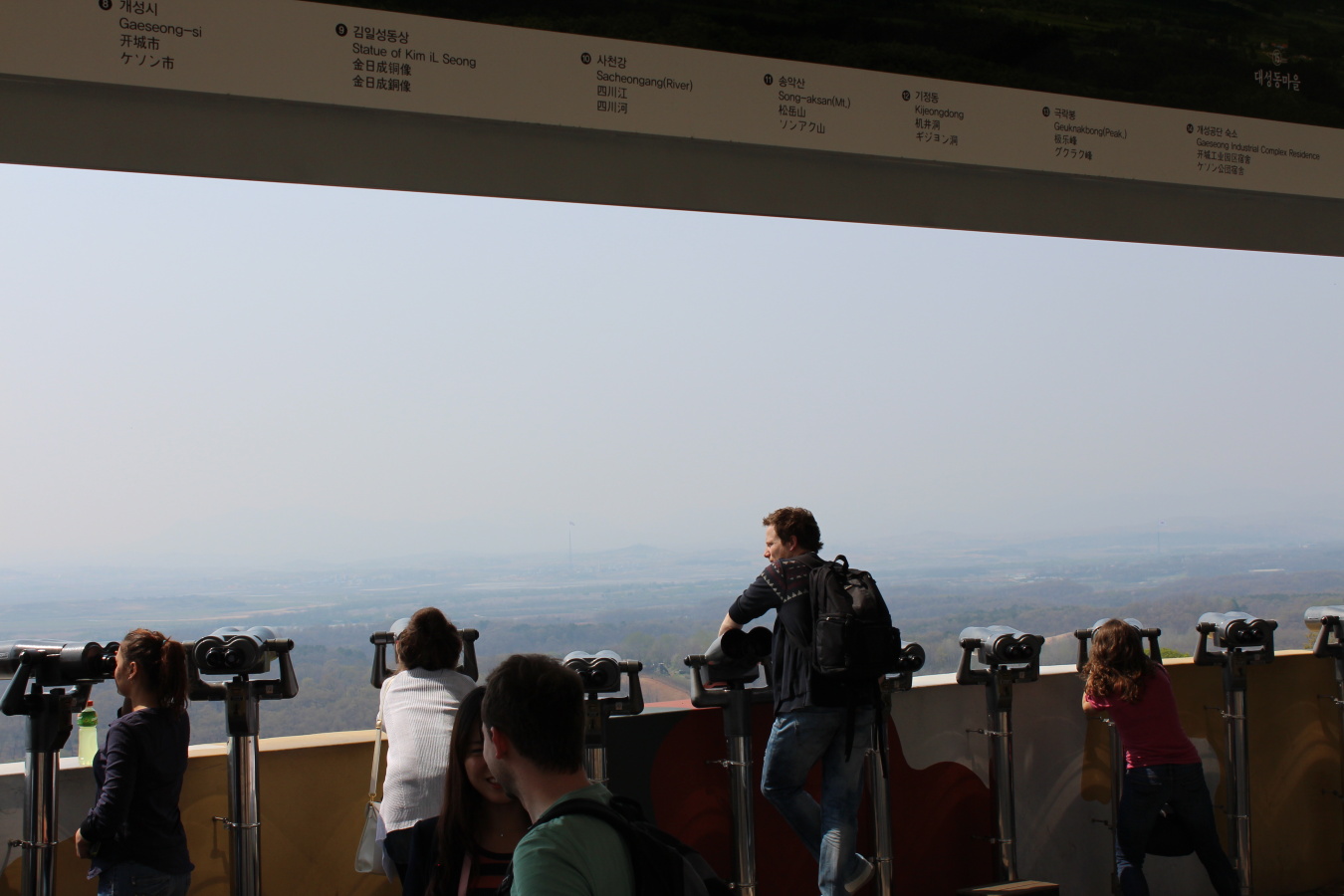
As close as I got to North Korea on this tour.  Still 2 km away, and quite hazy.

From here we traveled to the Dora Observatory. This lies right at the edge of the DMZ, and from here you can actually see North Korea!!  Unfortunately the air was hazy, but one could see Daesong-dong and its North Korean counterpart with their competing flagpoles.  In that area also lies the Joint Security Area (JSA) where North and South Korean forces stand face-to-face.  To the west we could see the Kaesong industrial complex, what was once jointly operated between the two Koreas but shuttered as a result of the recent verbal show between the two countries.  Our tour finished at Dorasan train station, an empty place built to one day lie on a train line between Seoul and Pyongyang.  Symbolic certainly, but strange that such infrastructure would get built for a reunification that seems long off.

The tour left me wanting more, as we didn't have the chance to actually cross into the DMZ and visit the JSA as some tours are authorized to do.  So I enjoyed the day and learned some South Korean history, and I will need to return for another tour of the border region.

So where do I board the train for Pyeongyang??

Sunday, April 21, 2013

Book Review: Korea, The Impossible Country

With 8 months under my belt here in South Korea and some sense for how things work in these parts, I'm continually surprised by how little knowledge of Korean culture or language a foreign face needs to show to impress many of the locals.  Just by saying a couple phrases of broken Korean that I have learned or knowing the names of the past couple presidents and I have somehow been able to wow people.  Just the other day, I surprised one of my Korean colleagues on my new team at work with my chopstick abilities in the Samsung cafeteria.  I understand that some foreign tourists might visit without knowing how to use chopsticks but I don't see how a foreign expat living here could possibly get by without this essential skill.  I would starve.

My foreign face made an impression on this Korean ajumma (who insisted on taking a photo with me).  In Daegu.

I've tried to be a student of the history and culture during my time here.  Indeed, I would feel even more out of place than I already am if I didn't have some sense for what was going on around me and why.  I try to keep my eyes open and observe as best I can, watch a little Korean TV every now and then (even when I can't understand what they are saying), and read bits of English-language Korean news.  Also, because the history of the country strongly dictates the culture, I've tried reading some books to improve my understand of what underlies the Korean psyche.  Korea Unmasked, by Rhie Won-bok, was a good start to learning about the differences between Korea, China, and Japan.  Ask a Korean Dude, by Kim Hyung-geun, is a quick and irreverent read detailing some of the quirks of Korean culture.  Recently I read Korea: The Impossible Country, by Daniel Tudor.  When he is not writing books, Tudor is Korea Correspondent for one of my favorite periodicals, The Economist. 

I very much liked Tudor's book because it tells the story of modern Korea from a Westerner's perspective.  It shows the strains and contradictions that have woven themselves into Korean society to create the country that exists today.  Since Korea is so poorly known to the Western world, Tudor's book fills an important need to better explain what modern South Korea represents to foreigners.  Tudor not only describes the ancient influences that remain very strong here, such as Confucianism, but also the influences on Korean music, business, politics, education, and other topics relevant for a full understanding of Korean life.

Tudor asserts his view of modern Korea in his book's title.  Korea's near-impossible ascendency from an impoverished backwater to a wealthy technological leader deserves to be studied, Tudor asserts.  But the book's title has a double-meaning.  Despite having pulled their country up by its bootstraps, Koreans remain the country with the longest working hours in the world, and children endure grueling amounts of education to compete fiercely for the few spots at top universities and Korea's all-powerful chaebol business conglomerates.  South Korea puts too much pressure on its citizens to conform to impossible standards of education, reputation, physical appearance, and career progress.  South Korea is now second to only Lithuania worldwide in terms of suicides per capita.  Tudor wonders when Koreans will uncork the champagne and relax a little.

I highly recommend Tudor's book to anyone embarking on an extended stay in South Korea.  Korea: The Impossible Country describes many elements of life here that foreigners should understand.  Why the Korean society is so sexist, for instance, and what women are doing to break through centuries-old barriers.  The source of Korean nationalism and its "bunker mentality" that resists foreign influence.  Why saccharine, similar-sounding K-pop sounds prevail on the radio.  What motivates some Koreans to spend a third of their after-tax income on private English education for their children.  I wish my blog can provide an understanding of some of these elements of life in Korea, but Tudor's work is far more thorough and intellectually nourishing than whatever I will be able to accomplish online.

Koreans invest a lot into learning English, but much of it I still don't understand.  Why so serious?