Sunday, June 28, 2015

Life of a Road Warrior

Working in an international-facing role at a Korean company for the last 3 years has not only forced me into a lot of late night and early morning conference calls, but also has put me on the road a fair bit. I also have had a long-distance relationship with a lady in Vietnam for over a year — Skype cannot fully bridge the gap between us. And, living as an expat in Asia means I am tempted by the many travel opportunities.
The pride of Incheon Airport — Korean Air

This entry will not reveal anything unusual for someone with a career in consulting or sales, but for me moving to Samsung in 2012 has kicked my life into travel overdrive. Every expat I know here has developed his own system for coping with the physical torment of overseas travel. This is my story.

Unlike for consultants, Samsung flies its employees below director level in economy class on all international travel (except for Brazil, which requires 23 hours flying time and is about as far away from Korea as you can get). Thankfully, we are usually (although not always) flying one of the two Korean carriers (Asiana or Korean Air) which offer more leg room and better service than most airlines (especially United and American … yuck!). Yet, flying 13 hours to reach New York or 11 hours to reach London is still quite a chore. There is only so much you can do when your seat bends just 10 degrees and you are trying to catch some sleep.

My glasses go on before a long flight
On top of that, I have walked off the airplane at JFK Airport in New York and traveled straight to a meeting — my counterpart looked at me like I was a zombie about to collapse. Alternatively, on my last business trip to the UK the Samsung Korean dispatchers insisted on taking us out for Korean food and drinking the night we landed at London Heathrow. My body did not know where it was and the soju shots compounded my narcolepsy.

Trying to mix business and personal travel can prove even more problematic. In late March, I flew from Germany to South Korea, leaving Saturday evening and arriving Sunday afternoon. Then, straight back to the office on Monday, jet-lagged and having lost much of my weekend to transit. I already had a trip planned to Singapore with my girlfriend departing Wednesday night — I unpacked, re-packed, ran out of the Samsung office in Suwon at 4:30pm to get to Incheon Airport (10 minute taxi ride + 70 minutes by bus from Suwon). Needless to say I was exhausted when I finally saw my girlfriend at 1:30am in Singapore’s Changi Airport. I enjoyed 4 days with her, then back to Seoul on a Monday morning red-eye. One can only push his body like this when he is young.

Everyone has their own coping tactics and I am no exception. For long intercontinental flights, I prefer the aisle seat on the inside of the plane — I like having the flexibility to walk around whenever I want, and by sitting inside you are less likely to have someone next to you. However, on red-eye flights from Southeast Asia I want the window — please don’t bother me! I put on my eye mask and headphones in my ears to block out the noise … if I do this right I maybe get a 4-hour nap before landing at Incheon Airport. Then, I head to the airport sauna — yes, Incheon Airport has a sauna in the basement! — take a shower and head straight to the bus for Suwon. I can usually take another 1-hour nap before arriving in Suwon, catch a taxi and plow through a workday… with plenty of coffee, of course.

For jet lag ... well, I still have not unlocked the secret to beating that. A couple things I try ... no napping when I arrive at my destination — this usually allows me to sleep well, at least the first night. I have tried taking a sleeping pill in the airplane but did not like it, it did not settle well in my stomach and actually prevented me from sleeping effectively on the plane. Some expats here swear by Ambien on the airplane, but that has some scary side-effects (Google it). I usually carry melatonin and feel safe taking that for a couple days after landing.

I curse United, but the Tokyo Narita to Washington Dulles flight is not bad

Traveling in Asia is certainly easier than in the USA — better airports, better airlines, fewer nerve-wracking flight delays and connecting flights, fewer strict cabin baggage policies, less crowded planes, and looser security policies. Nevertheless, I still yearn for the day when I can fly business class, or at least figure out the frequent-flyer game enough to get upgraded once in awhile :)

Wednesday, June 10, 2015

MERS and My Experience with Korean Health Care

As MERS (Middle East Respiratory Syndrome) cases continue to be reported in South Korea — at last count, 9 deaths and 108 cases — the community here is on high alert. Masks are flying off the shelves and schools have closed. Citizens are avoiding malls, sports arenas, and other public places. Some of the emergency policies enacted border on ridiculous — for instance, my colleague’s 2-week forced exile from the office for visiting Egypt (a MERS-free country) recently — but as you would expect the C.Y.A. policies come out in times of mild panic. My home country’s response to Ebola last year was similar.

People here are asking the natural questions: How did this happen? Will it get worse? The most important question to be asked is: What went wrong? In a country still stained by the Sewol ferry tragedy last year, local citizens are rightfully questioning the farcical initial response of government officials (which thankfully is improving).

I was comfortable when there was no MERS in the ER
In my opinion, the reason South Korea now has the largest MERS-infected population outside of Saudi Arabia is partly down to bad luck, bad management by the health system, and a bit of Korean culture. First, bad luck: unlike the Middle Eastern countries, South Korea is densely populated, making it easier for a virus to spread to new hosts. However, this doesn’t explain why the initial carrier went misdiagnosed for a week and visited 4 clinics in the meantime, or why a disease which only spreads in hospitals has found its way into so many (29 at last count).

The initial lack of transparency was appalling and certainly contributes to the spread of the virus. South Korea failed to learn the lessons of SARS, a far more transmittable but less deadly disease, by practicing the same censorship as the Chinese authorities did back in 2003. For two weeks, the hospitals were not named, creating a vacuum filled by all sorts of crazy rumors. In my 3 years of working for a Korean company, I have also often seen knowledge withheld between groups and by executives, leading to all kinds of false information.

In the meantime, many people unnecessarily and unwittingly visited hospitals carrying the disease, which brings me to my next point about Korean culture. In Korea, family members are far more involved in the care of a hospital patient than in Western countries, often sitting for days on end as their lived ones recover. In most cases, this is a rather pleasant practice — the community helps to heal its sick, so to speak. But when a deadly and unannounced virus is plaguing hospital emergency rooms, this leads many of these caring visitors to become afflicted with the disease. Also with proper infection-prevention practices failing to be applied, such as isolating the MERS patients, this has led to many more cases.

I personally had a rough spring this year with my health and spent more time in Korean hospitals than I certainly wanted, thankfully before the arrival of MERS. In late February, I gashed my shin after failing to complete a “box jump” at the gym, which I unwisely treated alone for a couple weeks. Finally during a business trip in March in Europe I visited a local clinic and received a cream, which did not work particularly well … so I started with the Korean medical system.

Fortunately Samsung has an on-site health clinic where I could see a general practitioner that referred me to a specialist at the local hospital. The level of English was not great for the doctor or the staff, but between their broken English and my broken Korean, and a helpful staff member on my team, I was able to schedule my next appointment.

I visited Ajou University Hospital in Suwon, a nice-looking and modern facility. Fortunately this hospital had an “international help desk” where people like me could call in advance for appointments, show up and be guided to the right place. The help desk also facilitated payment, and their English skills were quite good — I was happy to interact with them. With the doctors themselves, communication was definitely a mixed bag. The specialist doctor, an older man, was good at communicating with me and put me at ease. However, I interacted mostly with his group of younger staff, probably interns, who surprisingly could not communicate well with me. For instance, one of these interns instructed me that I would need to clean the wound daily on my own for 5 days before my next appointment. When I asked him for instructions on how to do this, rather than speaking to me he just typed them into his computer, and seemed surprised when I asked him to write down the names of the over-the-counter items in Korean. Bear in mind that these are some of the most highly-educated members of Korean society, and people who were in school learning English not so long ago. A sad reflection on the state of English-language education in Korea…

The treatment at Ajou, though, ended up being quite good, and inexpensive compared with the crazy American health care system. I only have a small scar on my shin which is fading over time.

Soonchunhyang Hospital, a well-known facility within walking distance from my house
Shortly after completing treatment for my shin, I noticed swelling in my foot. It was a Friday night and I panicked, so I limped over to the emergency room at Soonchunhyang (SCH) Hospital, walking distance from my apartment. Like most emergency rooms, it was not a pleasant place — I could hear a lot of crying from one room, and despite feeling fine except for my foot I was given an I.V. needle, which seemed excessive. A blood test was conducted, which thankfully found no infection in my blood, though I did have an infection in my foot, and I was prescribed antibiotics. The ER doc communicated very clearly with me, but left me with a huge wrap over my entire lower leg, leaving me unable to clean the shin wound that still needed some ointment.

I returned on Saturday and same drill as Ajou — see the international desk, speak to someone in English, then was directed to see a specialist. Like Ajou, SCH hospital was also very crowded, but I was able to get a few minutes with a guy who didn’t speak much English. He cut off the leg wrap, took a look at everything and told me to return on Monday, but didn’t do anything to clean my shin wound as I had asked. On Monday I returned, and he told me I was okay to walk with little explanation. Given his lack of communication, I wasn’t confident in his diagnosis, but thankfully it was the right one.

In short, for foreigners visiting a hospital in South Korea, you will probably be fine once this nasty MERS virus clears. But for those with children or anxious about your ability to communicate freely with doctors in a language you understand, research your options carefully in advance if you can. From talking with my expat colleagues, I have observed that Korean doctors tend to prescribe pills and treatments with little explanation, so tread with caution. In my experience, these treatments have generally worked, but others’ experiences vary. Korean doctors are not accustomed to being questioned by patients, and transparency about your treatment may be less than what you are used to. I think MERS will pass over the next 2 weeks, and I am hopeful that Korea can take the lessons learned from this episode to improve its health care system further.

Thursday, April 9, 2015

Long Bike Ride Day in Okcheon

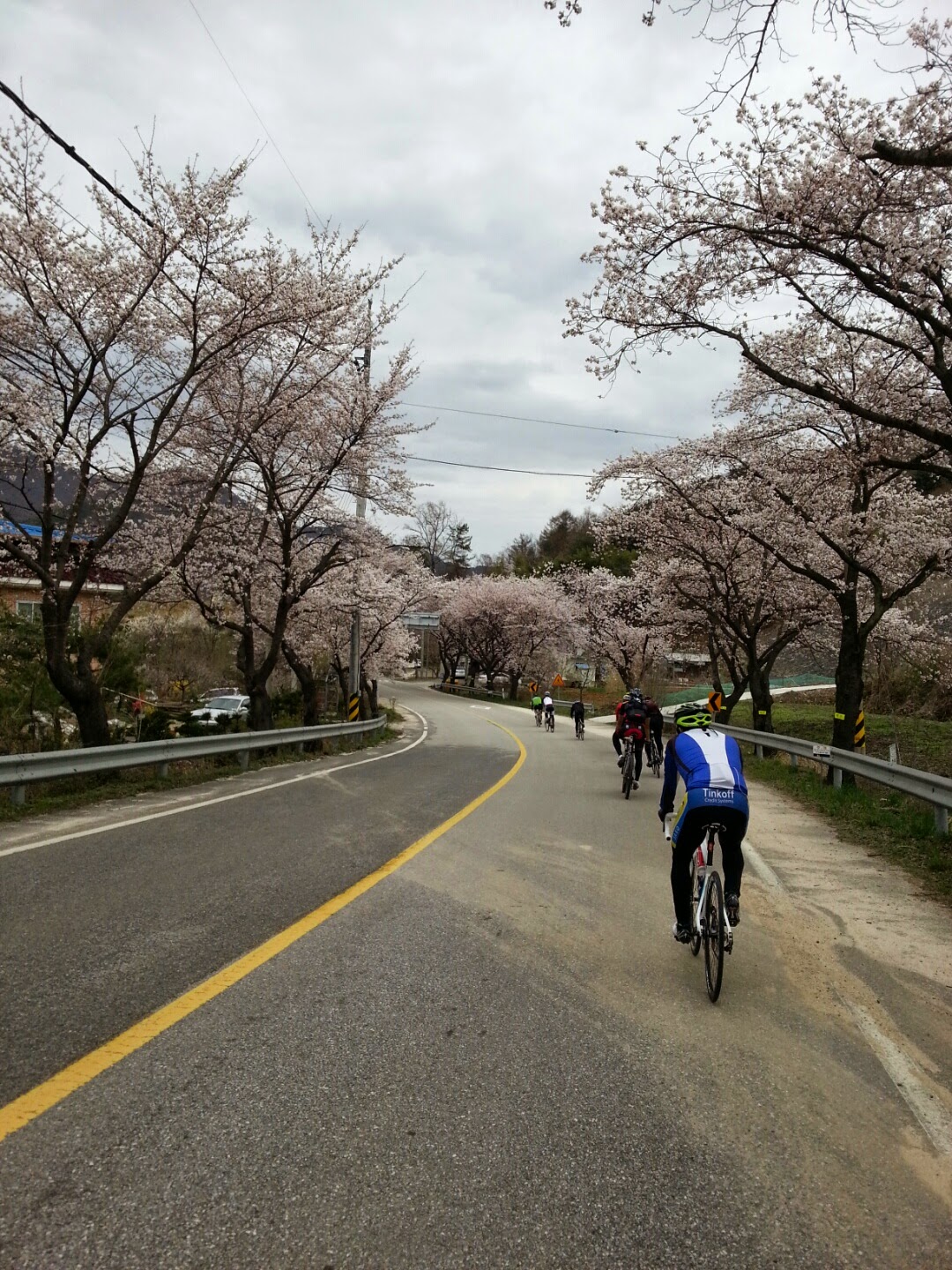
It sounded like a great idea… signing up for the Okcheon Riding Festival … “Falling in Cherry Blossom~” it was advertised. A work colleague on my KakaoTalk bicycle chat (I occasionally join for casual weekend rides along the Han River) sent out the notice — sure, why not sign up! I had already wired money to the organizers before I read the fine print: 73 kilometers. Or, as one of my colleagues put it, “So: I am in for the 73km Road. I am officially going to die.”

Yes, it was going to be a long way, but I have a good road bike, and have comfortably knocked out 40km rides along the flat Han River trail, so I was hoping for a longer, sunny version of what I was accustomed to, riding through dense thickets of cherry blossoms.

I had 3 colleagues joining me. We met at Seoul Station at 8:30am on Saturday and joined a group of 270 riders on a specially outfitted train with bike rack cars — including 30 foreigners: in Korea, the number of foreigners joining an event is always tracked! The train took 2 hours 20 minutes to reach Okcheon in the center of the country, and we rode 14km as a pack to the lunch stop. Not so beautiful a ride, some cherry blossoms had emerged, but it seemed like we had visited 1-2 weeks early. Most of the ride was through small-town Korea, and grey. However, it was a side of Korea one would not see from the city, sort of like a foreigner to the USA visiting Alabama.

The best of the blossoms
Lunch consisted of a Korean lunch box with some chicken, rice, kimchi, bean sprouts. Definitely could have used some more water — I’m glad we weren’t cycling on a hot day. In fact, the weather had turned downright chilly and dark clouds threatened. A brief mist passed and we carried on.

Cycling warmed us up again, and greeting us after lunch was a long, winding, switchback road up what felt like a never-ending hill. Marathon training in my old life (long since past!) had taught me the importance of keeping my legs moving, not stopping. Thankfully I had a cyclist in front of me pedaling at my pace, so I could track behind her for motivation. Just… one more push… and finally the top, then wind blowing by me as I bulleted down. I almost cramped coming off my bike at the rest stop.

Hill #1 took all the juice out of my legs, and steep hill #2 just wasn’t conquerable. I felt a sad sense of failure as I walked my bike up. And hill #3 was just torture… the steepest and highest of the 3, about a 300m climb or so. These hills were not well advertised. I felt my body giving up on me.

Finally at the top, another rest point, and the dark clouds that had threatened all afternoon finally opened up. Thankfully there was a small Korean gazebo there for all of us to cram into. There would be no more bicycling today. A bus came to pick us up to drive us back to the train station, and our bikes were loaded onto a truck. We had only made 42km of the planned 73 … but honestly I don’t know if I could have completed the rest of the ride in time to catch the evening train back to Seoul.

A little more truth in advertising would have been nice prior to this ride, though I did feel a sense of accomplishment in completing what we did. And I felt completely exhausted. I could have slept 12 hours like a baby at home afterwards, and would have had I not met a friend in Seoul from out of town Saturday evening.

So, a good first ride for the year. If you’re moving to Korea, a word of advice: bring your own bicycle! Like consumer electronics, bicycles are a lot more expensive in Korea than what you would find in Western countries. Some Koreans spend $5,000-$7,000 on a high-end bicycle!! There are some good trails and groups to join (foreigner or Korean) to fill any cyclist’s weekend appetite. Happy riding!

Sunday, February 15, 2015

Yongpyong Ski Resort: Korea Best, Not World Class

Two weekends ago my friends and I checked off one of my final to-do’s in the ROK — skiing in Pyeongchang, home of the 2018 Winter Olympics. We headed to the Yongpyong Ski Resort, which will be hosting the alpine skiing events in 3 years time. For my friends, many of whom will be leaving Korea when their employment contracts expire at the end of March, this was one final chance to experience the slopes of South Korea.


I had been skiing in Korea before, but never to Yongpyong as it is more distant from Seoul and really doesn’t make a good day trip. My friends and I set the alarm super early on Saturday morning to catch a 6:10am bus from Seoul’s Jamsil station … even without traffic the trip took 2.5 hours. Thankfully I was prepared to sleep the entire bus ride with my eye mask and noise-blocking earbuds. Offsite ski rental was a bit of a hassle, and all the ski shops were pretty humdrum, but at least we received free transportation to and from the resort. The morning was cold… -12C (10F) … and I was glad that I wore my extra warm sweater underneath my shell and my fleece jacket.

Finally by 10:30 we had reached the long line for what must be the world’s slowest gondola. The cable car was a bit snug for 8 people and the ride very long … maybe 15 minutes to reach the top of the mountain. At the top you are given only 2 choices: a long beginner/intermediate run that switchbacks down the whole mountain and a “double black diamond” run proclaimed “expert”. For my first ski run of the year, I wasn’t ready to thrust myself onto difficult terrain as I regained my ski legs, so we went down the easy path, which may have been a mistake… most of the easier slopes in Korea are overrun with people and this was no exception. Went through a bit of a gauntlet to get down weaving around the weaker skiers and hoping the super aggressive fast skiers behind decided not to run me over — like driving etiquette, skiing etiquette is lacking in Korea.


Fortunately, you can jump off the slow crowded slope part of the way down and explore some nicer (and more challenging) slopes off to the side of the mountain. None of the chair lift lines were particularly crowded. After a few hours of skiing my friends and I regathered for late lunch in the welcome center at the bottom, which seems to be the only place to eat a meal. The Japanese-style ramen restaurant disappointed — I think we were served spaghetti noodles instead of the real thing. Unfortunately, the long gondola line precluded much late afternoon skiing before the 4pm shutdown of the mountain, though we did make it down the “double black diamond” portion of the mountain where the Olympic downhill will be held. The difficulty level was highly overrated and I’m not sure how the Olympic organizers plan to make these slopes difficult for the racers. The snow was mostly manmade, due to a dry winter, and firm but not too icy.

One of my friends made a reservation at a nice pension house a bit away from the ski resort and the Pyeongchang town. A couple 4-bed houses connected to each other with the typical Korean stiff mattresses next to a little shack with a cozy common area. We enjoyed beers and a warm fire inside, then were picked up for a nice Korean BBQ dinner at one of the many beef restaurants in the area (yum!), then back to the pension for more beers and good company.


The next morning was an early start — 8am pickup — and not everyone had survived from the day before. Pension gave us a Sunday morning ride to the ski resort … how convenient! … and we headed up the gondola for coffee at the top before skiing down. Weather was again crisp but sunny on a picturesque morning … fog obscured some of the valleys below and the ocean was visible off in the distance … air quality was much higher in northeastern Korea! More skiing, late lunch at a decent Italian restaurant in the welcome center, dropped off the rental skis with the ski shop (who came to pick them up from the resort), and onto the bus back to Seoul at 3pm. At that time of day, returning to Seoul is an exercise in patience … the highways returning from Gangwon Province become parking lots. The 2.5 hour ride to Yongpyong stretched past 4 hours on the return trip.

My verdict on Yongpyong — it’s nice … for Korea. Definitely the best skiing I have experienced in Korea (my only other experiences being Phoenix Park and Vivaldi Park), but would greatly underwhelm a tourist expecting something grander like the Rocky Mountains or the Alps. Japan is a far better destination for the traveling skier and Yongpyong is only worth visiting if you happen to be in Korea for some other reason — there is no point in making the trip just for this. The mountain felt small and unsophisticated, dining options sparse and the snow quality not powdery (Koreans, I am told, prefer icy snow so they can ski down more aggressively). The accommodations around did not look very big or luxurious, and I imagine the Olympic time will be very crowded and uncomfortable around these parts. Maybe the Olympic organizers plan to dress up Yongpyong further — there is still time — but as it stands now the whole thing just does not feel “Olympian”.

Sunday, January 25, 2015

Who to Keep in Touch With?

I returned home to the USA for 2 weeks during the Christmas and New Year’s holiday. The trip was my longest home for personal travel since moving to Asia, and it was pretty great. I brought my girlfriend from Vietnam for her first trip to my home country, and filled the time with seeing family and friends between Charlottesville and New York City. End of the year has the usual travel frustrations, and there were also unplanned tourist frustrations with taking my girlfriend around … 40 minute wait to buy tickets for the MoMA, are you kidding me?

Was great to see my uncle and aunt over Christmas
Now that I am back in Korea — with the cold dark weather and the long daily commutes to the Samsung complex in Suwon — my mind is drifting and I am already planning my next vacations. Ho Chi Minh City in February for the Lunar New Year with my girlfriend, then Singapore in March to see some old friends that I haven’t seen in several years — a colleague from business school and a coworker from my first job.

Some time ago, a friend made a very prescient statement: “The social media age makes it much easier to maintain our weak connections.” This is absolutely correct. Just think… I live now in Asia… when I ride the bus to work in the morning and I click open Facebook on my phone, I’m seeing baby pictures from USA high school classmates of long ago. Those people are seeing my pictures of vacations in Cambodia or Thailand. Some are clicking “like”. Many of the people clicking “like” I haven’t talked to for several years, haven’t even sent an email to say “hello”. LinkedIn is worse… I have 500+ connections, some of whom I maybe visited once on a business trip or maybe attended my business school (I don’t even remember meeting some of my Darden connections). This week I posted an update on LinkedIn about my new job in Samsung — we went through a painful year-end re-org — and sure enough some of the random business connections were writing “Congrats!” If I met these people on the streets of Seoul I wouldn’t even recognize them…

As an Asian expat now for 2 and a half years, with potentially several years of living outside of the USA ahead of me, it strikes me as a bit odd that I keep these people in my web. Granted, there are a lot of people I haven’t seen in years who would bring a big smile to run into again. For example, an old work colleague of mine sent an email several months ago, asking if I could introduce him to Samsung — he is a patent attorney and well aware of my company’s legal struggles. This man lives now in Munich and I hadn’t seen him since 2008. But it was wonderful to hear from him, and when he came to Korea I took him out for BBQ in Seoul — what a great reunion! Another example: in summer of 2012 I went on a tour of several cities in the USA, to catch up with several people and say “goodbye for now”. The unanimous response from everyone I saw: “It was great to see you!” Certainly I was glad that I had Facebook as an encyclopedia to track where everyone had moved to.

Old friends are always welcome to visit Seoul
But, as life goes on and I continue to meet new people and link them on the “friends” list, I have to wonder if other people naturally fall off. Some people on Facebook brag about how they have gone through a spring cleaning of their friends — and how I survived the cut! — but I have never had the patience for this. I have tried. Inevitably, I feel I am making value judgments about people in my friends list and I am almost unable to distinguish non-friends from almost-friends. And so, I continue to hoard these people digitally, though most of them will never pass through Seoul just as I will never pass through Wilmington North Carolina or Essex Junction Vermont or Bergen Norway.

What do these people add to my life, really? And how could I really keep in touch with all of them? It would be exhausting! Malcolm Gladwell and other have written about the “rule of 150” — the idea (with science backing it) that a human can only realistically claim to maintain 150 connections at any point in time — and my Facebook and LinkedIn lists are several multiples above this number. I guess I have some feeling that one day these people will be “useful” to know, whatever that might mean, and maybe it will be good to meet up with them again.

Back in prehistoric times … by which, I mean 20 years ago! … a young man moving to South Korea like me would have had a very different experience. Probably the only sound of familiar voices would have been expensive calls home … with a calling card … to my parents. A few others would receive hand-written letters, which would take 1-2 weeks to cross the ocean. Maybe, maybe, I would have kept touch with 20 people or so. And that’s it! Everyone else would have been detached … those hometown friends and college classmates and B-school classmates and old coworkers and random friends of friends who I may have met at a party once upon a time. Certainly I would have been forced to integrate more thoroughly into Korean culture. I probably would have been more homesick. I wouldn’t know about all the marriages and babies or see the latest football scores — honestly, it would have been impossible to cling onto American life aside from the little conversations on the phone and the letters and photos which people would mail me.

A modern expat lives in a different world indeed. I see video of my girlfriend in Ho Chi Minh City almost every night. I send news articles to my sister in San Francisco, or maybe receive snarky messages when she has had just a little too much to drink. I watch NFL highlights on Monday nights when I return home from work — can even follow the live gameplay on Twitter when I ride the bus to work in the morning! An expat now can remain connected to old things, old ideas and old ways of thinking like never before.

Celebrating US Flag Day in Seoul last summer was great fun – but how many of these people will I be in touch with in 5 years?

Yet there remains no substitute for face-to-face contact. Hence why it was wonderful last month to eat a hamburger with my old B-school roommate in Charlottesville. Or great to hug my mom. Or to eat brunch with my old running partner. Maybe in another 20 years technology will have invented a way to simulate the touch of another person far away or communicate with someone who is asleep 10 time zones away. For now, however, being an expat still involves great loss. I have lost track of the number of weddings that I have missed while living in Asia — at least a dozen — and I will never meet the babies of many of my friends from my former life.

Once upon a time, humans all lived in villages and kept the same group of friends for most of their lives. Some people still live this way, but for a large number of people in this globalizing world of ours these times are gone forever. My old contacts from my old lives in Milwaukee, in Boston, in Washington DC, in Charlottesville, now in Seoul and in the future wherever I go next … who stays in my life and who fades away?

A true friend of mine, who I saw in New York recently, hacked together a great web app which collects all of the locations of your friends in Facebook and plots them on a world map. I click on this today and looked up my “friends” in Singapore for my March trip. An old classmate is there… yes I want to see him! Same with one of my old coworkers. But that other coworker now in Singapore, who I found really awkward back when we worked together … I don’t feel like ever seeing him again. One “unfriend” later and my digital friend web became just slightly less cluttered :)

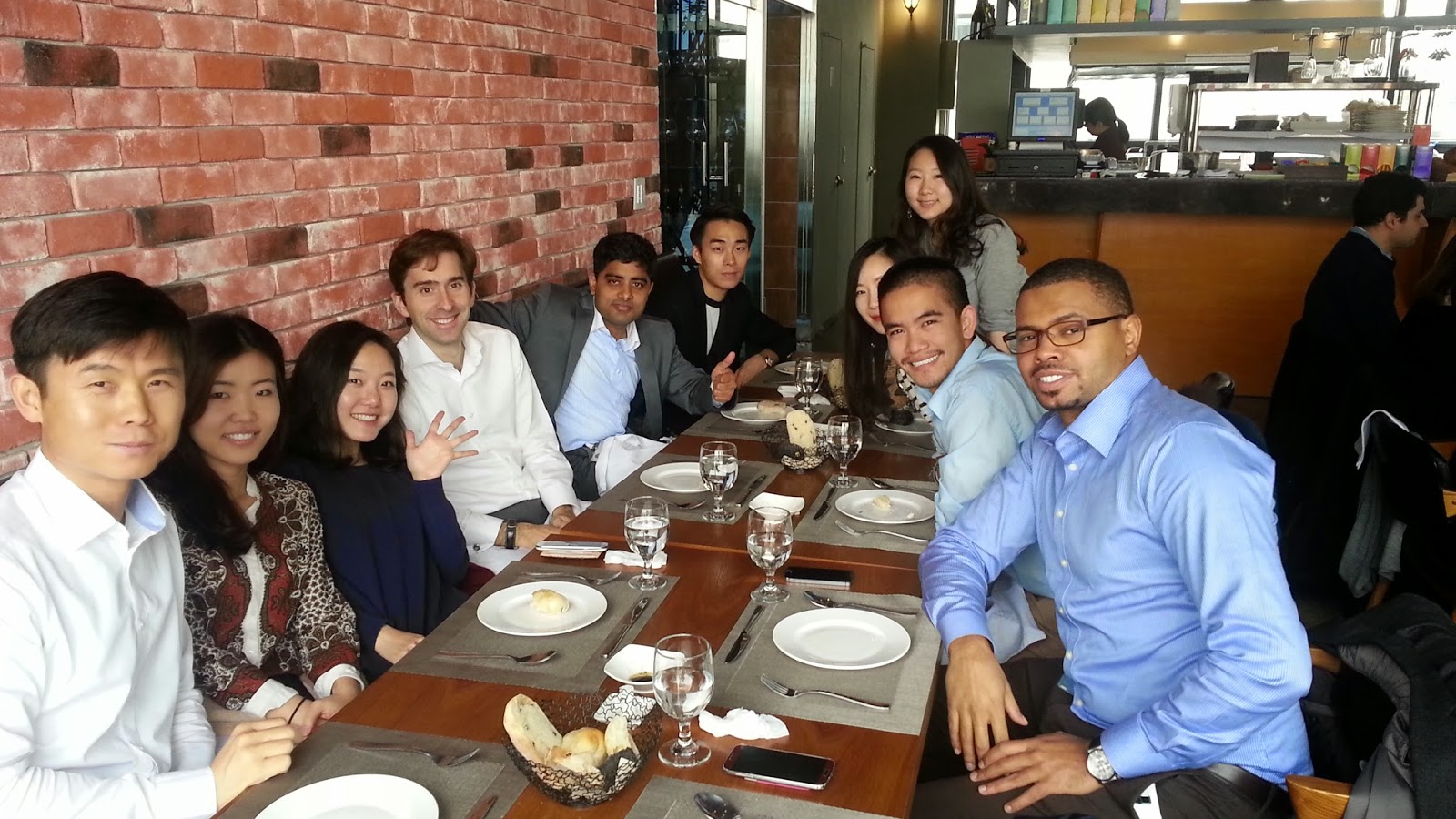
4 of 9 people in this photo have left Korea since our August 2014 dinner, and I start to wonder how many I will see again

Sunday, December 7, 2014

Diet

I had my annual company-provided health checkup recently and finally received the English-language results recently (the results first came in hieroglyphic Korean). Most everything was just fine and dandy, except that my total cholesterol was a touch high again this year. Last year my father, the physician named "Dr. Harris", told me that I needed to bring my cholesterol down, and I completely ignored him. "Things are happening to your body right now whether you acknowledge them or not," he warned. As I already get a reasonable amount of exercise (mostly from very early mornings at the gym), I saw my food consumption as something which I need to tackle.

In Korea, salad can be an anytime food!
I have never been a dieter. I'm generally conscious of staying away from fast food, sweets, binge eating, excessive amounts of carbs and all that. But though my diet is generally based around trying to eat more fruits and vegetables (and, hence, less of the bad stuff) I have never been strict about it. Nor have I needed to be. Since coming home one summer from college to have my mom calling me "chunky", I have never carried more than a couple excess kilograms. Since moving to Korea, my weight has stayed lower than when I lived in the US. And there is a reason for that: portion sizes at restaurants are smaller here, and I walk a lot more nowadays ... I have not owned a car for over 2 years.

But, heeding my father's warning for once, I decided I wanted to try to be more vigilant of my eating. Time for a diet... or, as the Koreans say, "DA-EE-OH-TUH!"  (다이어트)

So, protein shakes from the gym are out -- I don't know what is in those. Milk too -- unnecessary calories and fat. Out with cholesterol-heavy egg yolks. More fish-eating in the Samsung cafeteria and less pizza, pasta, fried pork cutlet... oh those things are so delicious though! And, I decided to try logging my foods last week into the Samsung S-Health application built into my new Samsung Galaxy S5 phone.

Spicy squid and a lot of foods that S-Health did not classify without a fight
Monday morning rolled around, and as usual I headed straight off the long bus ride from Seoul to Samsung Digital City in Suwon, darting towards the basement cafeteria in the Mobile R&D building. This cafeteria is quite new and most foreigners in Suwon like it for the ample variety of foods -- not everything is Korean food! I grabbed my usual morning salad, something I never considered a breakfast food until I moved to Korea, where I have learned that salad could be an anytime food. I sat down with my plastic tray, whipped out the phone, and here I went. Cherry tomatoes...uh oh, "Set Portion Size". My choices are cups, grams, and calories. Now I have no idea how many calories are in cherry tomatoes, and I struggle with the metric system, so cups... how many are 3 cherry tomatoes? 0.3 cups?? Sounded good to me! Sweet potato, maybe 0.5 cup? Rotini, grated parmesan cheese, lettuce, radishes, 2 cooked egg whites. I was already tired of this experiment! The app counted 326 calories...no salad dressing helped keep that number down.

Next, lunch in the Samsung cafeteria. For better or worse, I typically eat 2-3 meals per day in the Samsung cafeteria in Suwon. There are several reasons for this: I am not a great cook (and a lazy one at that), the food is convenient, it generally seems healthy (if I make the right food choices), it is dirt cheap (heavily subsidized by the company). And let's face it, I now commute at least 50 minutes each way to work now, and if I'm working late then eating at Samsung cafeteria is my only antidote from preventing starvation.

jin-mee tong-dak, seaweed soup, and the ubiquitous purple rice
With my newfound dedication to seafood, I went for spicy boiled squid. And again, whipped out the app at the lunch table. This time, I used the photo-taking option in the app to document my food, but this doesn't enter any information into the app. So, manually plugging away...  boiled squid, white rice, bean sprouts, dried seaweed, cherry tomatoes, pineapple chunks, kimchi, honey-baked ham, potatoes, miso soup, red pepper paste. I had no idea how to classify the white sauce covering the fruits. Though the menu board outside the cafeteria helpfully posts the estimated calorie values for each meal (most are 800-900 calories), I still found entering the portion sizes difficult and tedious.

I eat a lot of snacks at my desk during the day, and now I needed to input those too! 2 americanos, 30 almonds, 4 tangerines (in season now), some of my colleague's bagged popcorn, 3 mini-bananas, a red pepper.

For dinner, I skipped the cafeteria, and ordered a takeout salmon salad from Greenbasket, a gem of a little salad restaurant between the bus stop and home in Seoul. Again, I tediously estimated portion sizes and avoided the salad dressing. Still starving after the salad, I chugged a few glasses of water and ate 60 grams of cashew nuts (don't remember *how* I calculated that). For Day One: 2,508 calories. And to think of how many calories I burned trying to enter my foods into the S-Health app! I was hungry and tired of dieting already.

Thank God for Greenbasket!
The rest of the week got logged too...
Tuesday (2504 calories)
Breakfast: salad topped with tuna croquette.
Lunch: Spicy tuna stew, with a side of tofu, kimchi, seaweed, and purple rice. Turns out that purple rice is just white rice stained with a sprinkling of black rice. The things you learn when tracking your diet! (S-Health, of course, did not have an entry for "purple rice").
Snack: Mini Bananas, Carrots, Tangerines. I cheated when my coworkers started handing out chocolate and crackers in the afternoon, as well as a couple of the Honey Butter potato chips which Koreans are obsessing over at the moment (no idea why).
Dinner: Again went to Greenbasket (thank God for that place!). Salad topped with grilled chicken, again skipped the delicious dressing, again starving afterwards.
4th meal: Starving, so I ate cashew nuts and a cup of yogurt.

Wednesday (2737 calories)
Breakfast: Salad topped with Fried tofu
Lunch: Grilled mackeral with tofu stew, dried anchovies, kimchi, and some korean leaf which I didn't know the name of (neither did my silly S-Health app, of course)
Dinner: This time I made it a full 3-meal day at Samsung cafeteria! Tofu with rice, mushrooms, seaweed, zucchini, radishes. Side of chicken sausage.
Snacks: the usual, plus an energy bar I bought from the convenience store near the bus stop on the way home (as I was again starving!)

Thursday team lunch (I am not in the photo... it is my work team, trust me!)
Thursday (2772 calories)
Breakfast: Salad with a side of regular tofu
Lunch: Today we had a team lunch at a local steak and pasta restaurant near the Digital City. Per Korean custom, we shared a lot of small dishes which provided delicious variety, but made it hellish to record. Especially having the phone on the table the whole meal led to some teasing from my teammates. Besides steak and linguine, fruit & nut bread, olive oil, lettuce + cherry tomatoes, roasted potato, portabella mushrooms, truffle balls and brownies for dessert.
Dinner: Another meal out, this time with alums of the Darden business school living in Seoul. We met at a Mexican food restaurant, and again shared dishes family-style. To not be completely obnoxious, I did not keep my phone on the table and I worked hard to mentally record everything going into my mouth: chicken burrito, chips with guacamole, french fries, fried calamari, 1 porter beer.
Snacks: The usual + a slice of banana cake (with icing) I received when we celebrated my colleague's birthday.

Friday (2980 calories)
Breakfast: Salad topped with bacon
Lunch: A Korean style chicken dish, jin-mee tong-dak (진미통닭). Seaweed soup, crabmeat mixed with carrots ad cucumbers, seaweed, cabbage, and the purple rice.
Snacks: The usual fruits/vegetables plus a chocolate chip cookie gifted to me by a teammate.
Dinner: I ran into one of my colleagues as we were dropped off the Samsung shuttle bus in my neighborhood and followed him to a sushi restaurant. As you can imagine, sushi restaurant completely defeated S-Health. Being able to identify every type of fish and side dish while eating in a foreign country is almost impossible. Plus I was so tired of obnoxiously logging everything that I again tried to mentally record everything, but the sake inhibited my memory substantially (and sake has a lot of calories, who knew!).

The first of multiple dinner plates at American Thanksgiving in Korea (on Saturday)
So, as you can see, actually tracking what you eat is an exhaustive, and exhausting process. S-Health was difficult to use: though you can take pictures of what you eat the app does not do you any favors by identifying the foods you are eating from the pictures. Units are sometimes unconventional and can be difficult to estimate when you are not preparing everything yourself -- even then you would need to measure all the portion sizes quite closely. The app seems built for the American customer as it lacked even Korean foods, and I also could not enter the names of niche Korean vegetables in the Korean language. This lack of Korean support is strange because so many parts of my phone only speak to me in Korean jibberish.

In summary, diet tracking was every bit as painful as you can imagine. Last Saturday I celebrated American Thanksgiving with my friends, and per American custom I gorged on the feast of foods we had available (my friends are quite excellent chefs). No calorie counting, of course!! At the end of the meal, I lay down, satisfied with my gluttony and my complete annihilation of all the fastidious diet tracking.

The American Thanksgiving party... strike a funny pose!

Sunday, November 2, 2014

Running in Korea

After moving to Korea my running habit has mostly gone on hold. Before business school I had become quite competitive in races ranging from 5km to marathon, and during business school also I would run frequently as a way to overcome the stresses of schoolwork and job searching.


But my first run in Seoul was not pleasant – under an overhead highway along the Han River at night. There is really nowhere else nearby to run in this crowded city, and after coming home that evening I felt sick. The regular smog in this city is a regular reminder of the perils of consistent aerobic activity outdoors – the air is not "China-bad" but it is still not good. Before moving here I was told that "Koreans don't really go jogging" and have seen that bicycling and walking are far more popular instead. After a winter of getting fat and lazy I finally joined a good gym near my house in April 2013 ... first time in my life that I ever signed up for a gym membership ... and I haven't looked back.

That said, my foreign colleagues at Samsung were a little more eager for running last year. We started with the Color Me Rad 5K in July, which really was more of a walk. In fact, I would estimate that about 90% of people walked the course. I have never seen so many people walking on a "race course". There were no time chips and the event was meant to be a good time, but I still was surprised that other people weren't jogging this thing. My foreign colleagues ran at a warmup pace and still easily passed hundreds of people. There was a ton of dry paint thrown at us and a great DJ blasting dance music at the finish line. It was fun.

In the fall we became more ambitious and signed up for the Pink Ribbon 10K in October 2013. Thankfully our fabulous Korean friend Hyewon signed us up on the Korean website, and we had a beautiful mid-autumn day to run on Yeouido Island. The event was designed to raise breast cancer awareness and I have never seen so much bright pink in one place! Despite absolutely no outdoor jogging I managed to run pretty decently -- nowhere near my peak but still was top finisher in my group. And given that there were maybe only 50 foreigners which I saw in the whole race, I could easily have been the top foreign finisher!

The next week a few of us double-dipped and ran the Seoul Race 10K along the Cheonggyecheon Stream. Was a bit chillier and a more serious event. This was the first race where the real Korean runners came out ... the ones who crank out 6-minute miles in their sleep. I might have been at that level long ago but not now -- nonetheless, I still managed to turn in a decent performance.

The highlights for Seoul Race were certainly off the course though. Before the race as we gathered in City Hall Plaza, a TV camera crew walked up to my group of foreigners for an interview! I will never know who got to watch my tape of me talking about life in Korea, but it was certainly an experience which I wouldn't have back home. Then after the race was a concert and my friend Whit got selected to dance with the band. Oh expat life!

Strange foreign dude dancing at the end of a race course... ALERT!!
This year, some of my racing friends moved out of Korea and there were no races until I joined some of my gym colleagues at Spartan Race Korea. The race was in hilly, scenic Pyeongchang – home of the 2018 Winter Olympics. But given the amount of traffic we endured to get there from Seoul on a Saturday morning, I think I will avoid the games in 4 years time. The race was sponsored by Reebok and I think the U.S. Army shipped an entire brigade to the race course, so I didn't feel so out of place as a foreigner here.

Not so muddy before the Spartan Race...
As the 7km course essentially went up a ski mountain, and given the substantial obstacles one had to clear to get to the finish line, this was not going to be a fun run. We jumped into mud pits, we ran on rocky mountain trails through the forest, we jumped walls, ducked under barbed wire, climbed ropes ...well, I wasn't able to do all of it, and given my uncertainty about the obstacles I didn't run quite my fastest, but this was fun and I was glad to have endured this. Still managed to finish in the top 10% overall, so I may need to do more obstacle racing in the future!

...just a tad muddier and more exhausted at the end.
In short, running exists in Korea, though not nearly as popular as back home in the USA. Running races as a foreigner is not difficult ... though it helps to have a Korean who can navigate the language and payment barriers on some of these websites. And, as with many things in culturally homogenous South Korea, you're a bit of a novelty racing as a foreigner, obstacle races excepted. The days are starting to turn chilly in Seoul now but I hope to be back for more races in 2015!