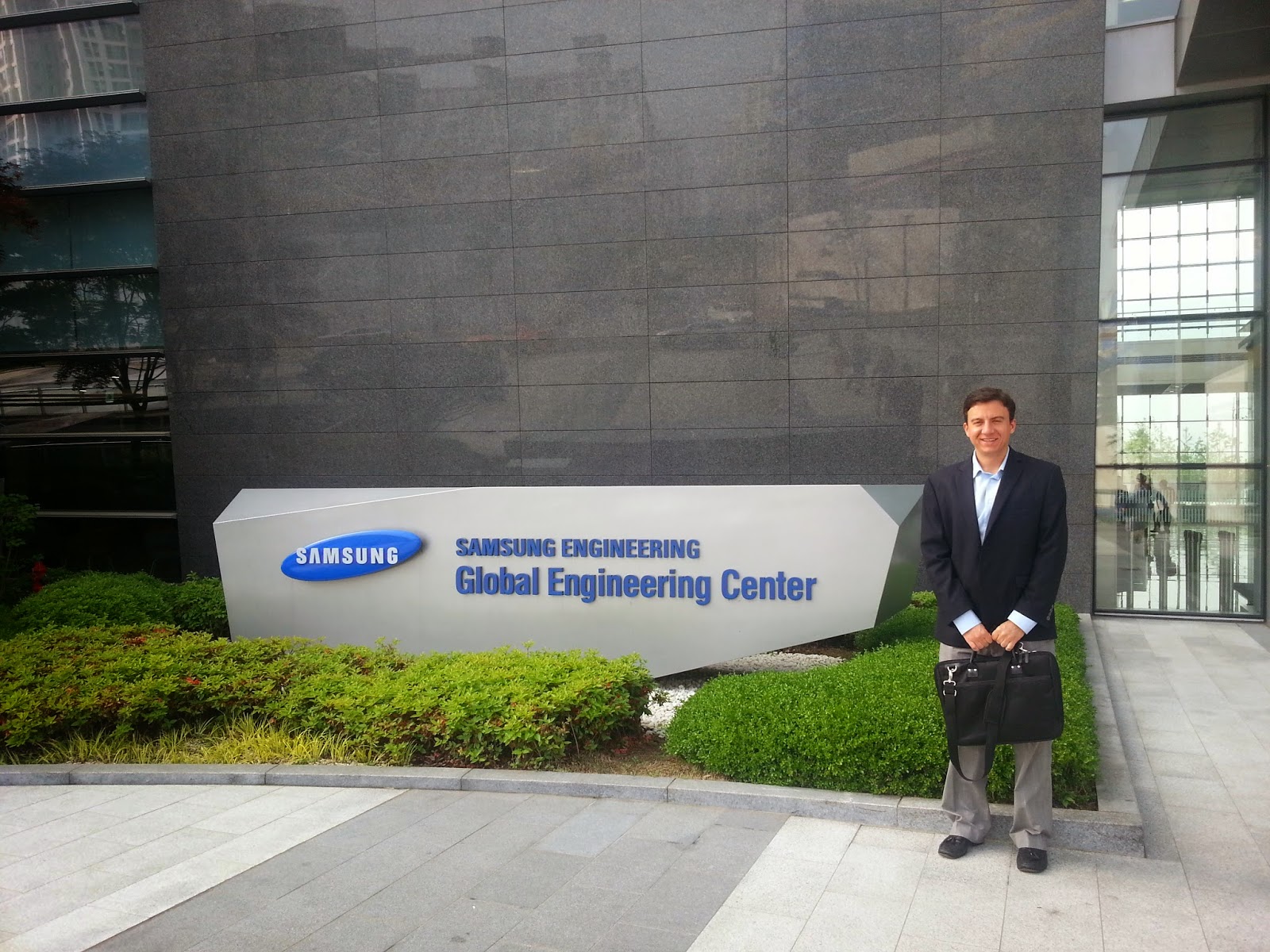
Sunday, August 31, 2014

Boryeong Mud Festival

I moved out of Samsung Global Strategy Group 4 months ago and transitioned to a job in a Samsung Electronics' sales group in Suwon. I miss the short commute I once had to GSG's office at Samsung headquarters above Seoul's Gangnam Station, and I was invited back recently on a Friday afternoon to discuss my new job with people still in the group. After this meeting as I stopped by to say hi to my former Korean staffers, one asked me, "Jonathan, do you have plans tomorrow?" Lucky me – I did not – and I was invited to a GSG-organized visit to the Boryeong Mud Festival. All I needed to do was set my alarm and reach Gangnam by 7:45am on a Saturday morning. I could do that!

I am a little bit muddy
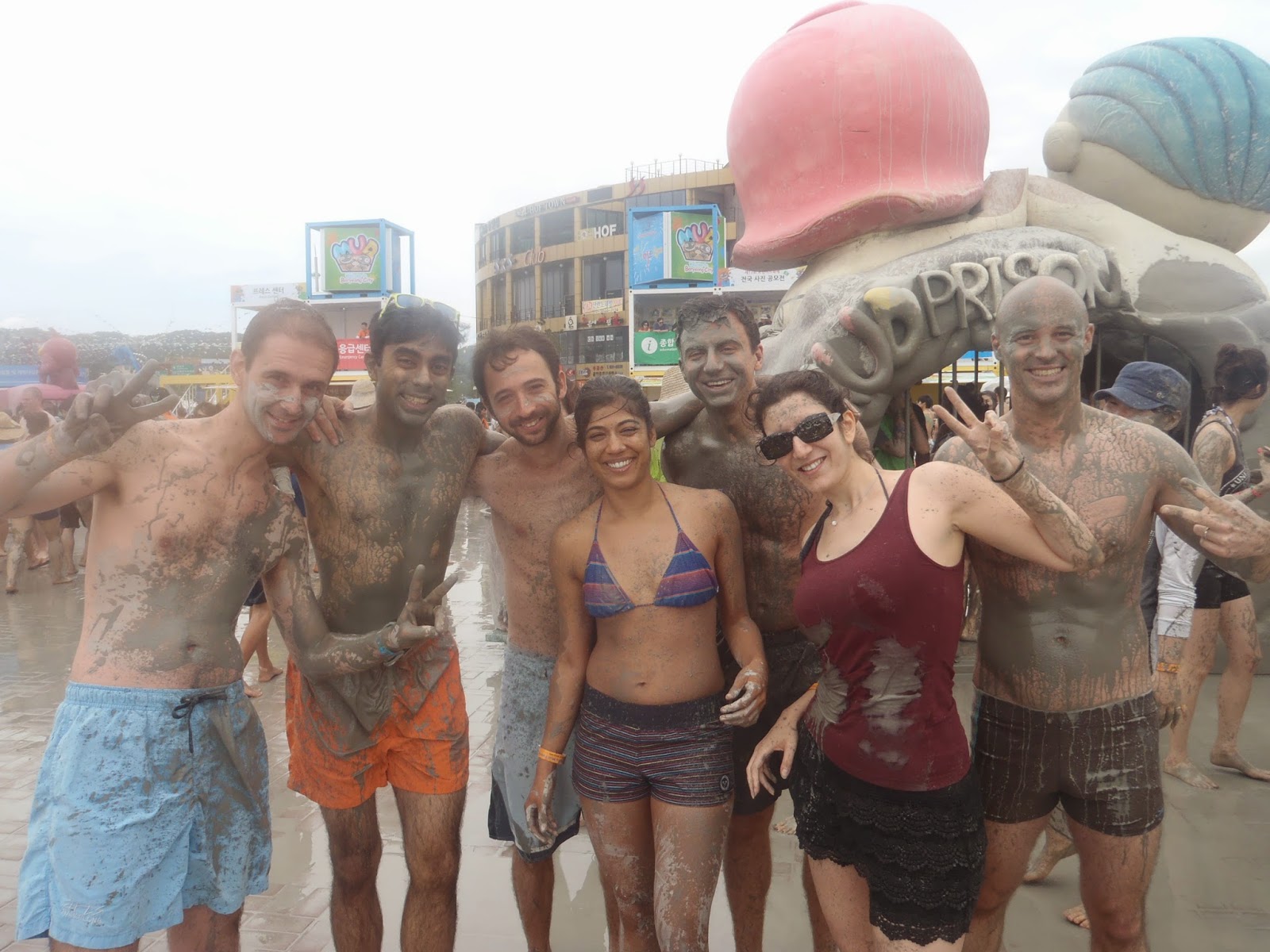
Boryeong Mud Festival is hosted annually on Korea's western coast, about a 2-hour bus ride southwest of Seoul. GSG chartered a bus and I caught a nice nap on the ride over. We had a cloudy day, but no rain (thankfully rainy season this summer was much drier than last), and temperature was mild but not too hot. For someone looking to protect white skin, it was a good day to be outdoors!

When we arrived we walked past rows of buses with US military personnel. One of the Koreans in our group commented, "I feel like a foreigner here!" Though Boryeong Mud Festival is popular with expats, it was not the foreigner-fest that maybe some Koreans had feared – the domestic population was well-represented as well.

Our group set up camp on the beach and paid a couple guys to bring over umbrellas to cover our area. I was nicely surprised by the quality of the beach ... good sand and big waves crashing down on a windy day. Definitely the nicest beach that I have seen on the west coast of Korea. We took the compulsory group photo, then set out for the mud festivities nearby. "Should we leave our wallets and cellphones in our backpacks?" "It's Korea... it's a super-safe country... our stuff will probably be fine." Maybe we were too trusting in just leaving our valuables unlocked along the beach as we went to play in the mud, but true to expectation everything was as we had left it when we returned.

The festival mud area consisted of a series of inflatable stations, mud wrestling, mud slinging, and any other conceivable activities that one could do with mud. The mud that was used looked like the sea mud which one sees along much of Korea's western shore, and it was a bit watered down, but we all became quite dirty nonetheless. We started in "mud prison", where mud was hurled at us as we went behind bars, followed by an inflatable mud obstacle course which ended with a fun mud slide. Others waited in line for the mud wrestling and other events.

Compulsory group photo on the beach ... pre-mud
By mid-day, the queues had become quite long, so we retreated to the beach, where the leader of the group met us with fried chicken, beer, and Korean snacks. Not so good for the diet, but good for a lazy weekend on the beach. I did not know a lot of people in the group – several were GSG interns working in Korea for the summer – but it was still a good time. During the afternoon a few people napped on the beach while others walked towards a big stage where a DJ had set up to lead a beach rave. Young Koreans love bobbing their heads to the nnnsssst nnnsssst nnnsssst of house music, and the scene felt like something one might experience on Miami Beach or Ibiza.

Mud Festival made for an enjoyable Saturday, and I would recommend to any young person who happens to traveling around Korea during late July next year!


(all photos courtesy of Kisub "Keith" Song)

Sunday, July 13, 2014

Korea's Coffee Obsession

Starbucks in Insadong
One thing that visitors to Korea never need to worry about is where to find a caffeine pick-me-up. Whereas most office buildings seem to carry the awful ready-mix stuff, the preferred drink of choice is the espresso-style drinks served up in the nation's coffee shops. And are they ever booming?! Some amazing stats:

  • Reuters reports that the number of coffee shops in South Korea increased nearly ten-fold from 2006 to 2011
  • According to The Atlantic, Seoul has more Starbucks locations than any other city in the world, even beating New York
  • Wall Street Journal reports that due to fierce coffee shop competition South Korea’s Fair Trade Commission banned coffeehouse chains from opening a new shop within 500 meters (1,640 feet) of each other
  • According to Forbes, Korea's #1 coffee chain, Caffe Bene, which reached over 900 locations since launching just in 2008 (Starbucks has over 600 since entering Korea in 1999), is now planning to invade the USA by expanding internationally
The coffee shop closest to my house: Zephyr Beans
The coffee craze in Korea can be explained by a few factors. Koreans are overworked and lacking sleep, at least relative to other OECD nations (see Figure 2.5 of this study). Korea is a highly group-oriented society and the coffee shop serves as a great place to meet up – for youth who need to escape from the watch of their parents this is especially true. Younger Koreans are also very alert to new trends and are now absorbing elements of American/European culture into their lives.

These factors help explain a few of the differences in the Korean coffee scene, at least relative to the American coffee culture that I grew up with. For one thing, coffee in Korea tends to be very expensive. Most people don't bat an eye at shelling out $4 to $5 for a cup. The explanation for this cannot be just supply chain differences – $2/cup coffee can be found if you know where to look. However, when you consider that Korean coffee shops tend to be rather large, even in crowded Seoul, and you think about the high rents that coffee shops must pay here, the high prices start to make sense.


Another difference that my friends and I noticed rather quickly is that finding a cup of fresh coffee before 10am is not all that easy here. Morning coffee shops do exist, particularly near large office buildings, but coffee shops in Korea tend to open late and close late, usually around 10pm-11pm. Some coffee shops in high foot-traffic locations like Gangnam and Itaewon even stay open all night. Whereas the American office worker has become conditioned to pick up her first latte at 7am on the way to the office, Koreans tend to wait until lunch hour to have their first cup of the day. Coffee for Koreans means friends and colleagues, and you will find more people drinking coffee here in the evening than at morning commuting time.

Because Koreans spend so much time sitting in coffee shops, the interior decors can be quite intricate. Though the chains seem to prefer dull uniformity, independent shops seem to exist in almost every neighborhood with unique wall art, plants, and music. This blogger has an excellent photographic set which captures some of the scene.


As far as tastes, Koreans greatly prefer espresso drinks to drip coffee. Perhaps the Starbucks influence explains this. I find it a tad ironic that, despite being American, I never drank americanos until I moved to Korea!
(Somewhat related, a good song by a Korean indie band about the Americano on YouTube)

To document some of this Korean coffee obsession, I went on a journey last Saturday to photograph every coffee shop I could see between my house in Hannam-dong and my former office at Gangnam Station, a journey of about 6km. I counted roughly 50 coffee shops over that stretch just along the main road, which doesn't even count the hundreds that lie in the back alleys. Following is a selection of photos...

I sent this picture to a friend in the US who was missing Coffee Bean
I didn't know that Caribou was #2 US coffee brand...until I saw it printed on a coffee cup in Korea
Yes, Korea has Krispy Kreme ... and Dunkin' Donuts!
The dominant Caffe Bene ... but really nothing special about this chain

Sunday, June 1, 2014

Exploring Jeju Island

In 2013 I spent a lot of time exploring the Korean peninsula – to the point where I had some Koreans telling me that I had seen more of their small country than them! But the one place on the Korea bucket list that I had not checked off was Jeju Island, located in the sea south of the peninsula. Most Koreans were surprised... "You have not been to JEJU??? It's sooo wonderful..."

Given that Jeju is by far the #1 location for domestic tourism (Seoul to Jeju is one of the most trafficked flights in the world) I agreed that I had to see the place. Would Jeju live up to its claim as "the Hawaii of Korea"??

Eating black pork was definitely the best thing to do on Jeju

Fortunately in early May a confluence of holidays (Labor Day, Children's Day, and Buddha's Birthday) created a "Golden Week" and made for several days off from work. My friend Xuanhoa visited from Vietnam, and as it was her first time visiting South Korea I thought Jeju would make a perfect trip. Unfortunately, traveling anywhere from Seoul is hellish during a holiday period – 20 million other people have the same idea to travel as you do – but I took the plunge on air tickets (3x the normal rate) and thankfully found a guesthouse accommodation through AirBnb so we didn't need to stay at one of Jeju's exorbitantly priced hotels.

The flight from Gimpo Airport on May Day Thursday was simple, just over an hour, and we were able to drop off our bags off at the guesthouse in Jeju City just in time for dinner. There is not much to Jeju City, but thankfully our accommodation was walking distance to a street full of restaurants serving Jeju's specialty – black pork! A restaurant which claimed to have a Michelin rating (??) had a long line of customers waiting outside, but we found another nice-looking restaurant nearby and were seated at a corner table. Korean barbecue is always a hit with foreigners (besides the vegetarians, of course), especially when you get prime cuts of pork thrown on the grill. Our first meal in Jeju was goooood! Very full after dinner, Xuanhoa and I spent the evening walking to the waterfront and watching the steady stream of planes landing at Jeju airport on the flight path from Seoul.

If we were driving our own car, we would have spent more time at the beaches on Jeju

I had been told by Koreans that Jeju requires renting a car to really explore, but unfortunately my international drivers' permit had expired and I haven't gone through the trouble yet of acquiring a Korean drivers license (you never need to drive yourself anywhere in Seoul). Thankfully our guesthouse hostess, Suyeon, had reserved a taxi to take us around to the sights on the east side of the island on Friday. All things considered, for the 100,000 won daily rate ($98), it was not a bad value. Our driver didn't speak any English, but I knew enough Korean to communicate with the driver where to go.

We had a list of recommended attractions from Suyeon, and started at a couple nice beaches (Hamdeok and Gimnyeong). Unfortunately with a taxi driver you can't really linger at the beaches because he just wants to shuttle you from place to place so his day ends at a reasonable hour. Next we went to Manjanggul Cave, a UNESCO World Heritage site and "one of the finest lava tunnels in the world", but frankly it was really dull. Just a big long cave that takes about an hour to walk. After Korean food for lunch (grilled fish + kimchi stew), we visited the postcard attraction of Jeju: the Seongsan Sunrise Peak. From the outside this volcanic crater looked really impressive, and we were excited to hike it on the warm May day. But at the top you don't have such a great view – there is the grassy crater next to the sea but really it is underwhelming compared to what you expect. I thought Jeju's air would be clean (I hate mainland Korea's air pollution) but from the top of Seongsan the view was still quite hazy. From there, it was a short drive to the Seopjikoji, scene of a famous Korean drama that I have never watched, and though it was nice to be along the coast it certainly was not "breathtaking", as some of the online reviewers had claimed. Our final stop on the day was the Daheeyeon Garden, a kitschy green tea plantation.

The top of Seongsan was underwhelming, but we got this cool picture with a random Korean dude in a bear costume

On Saturday we got cheap and decided not to rent the taxi again. Rather we thought we could get to the south side of the island (towards Seogwipo) by bus. Not a smart move. Though there are buses which run to Seogwipo from Jeju City we ran into trouble when we wanted to move from place-to-place along the southern shore. We started at the Cheonjeyeon Waterfall, which I had read was "Jeju's most famous waterfall", and actually was nice and peaceful. Then, with no taxis or buses in sight, the long painful walking began. We started by walking to the Teddy Bear Museum, about 30 minutes by foot, after which Xuanhoa decided the museum wasn't worth visiting anymore. So we continued the long walk (another 45 minutes) to the Jusangjeolli, described by Wikipedia as a "spectacular volcanic rock formation". However, the Wikipedia entry must have been written by Koreans because this formation was rather underwhelming – and uncomfortably crowded. When we arrived, the first words out of my mouth were "Is that it?" The Jusangjeolli was not worth the walk. To find more things to do, I did a little web research on my phone and discovered that the "most famous waterfall" is actually named Cheonjiyeon, not Cheonjeyeon. Yes, these both exist along Jeju's southern coast. I'm guessing I'm not the first English-speaking tourist to be confused by this. The second waterfall (Cheonjiyeon) was far too crowded and not a good time investment compared with the less famous, similarly named Cheonjeyeon Waterfall. After too much walking on a hot day between too many disappointing sites, Xuanhoa and I had reached the limit of our patience and found a bus back to Jeju City, where we ate at the same delicious black pork restaurant as the first night. Yum. Eating was the best thing to do on Jeju.

Cheonjeyeon Waterfall was nicely uncrowded compared to its more famous cousin

Sunday morning we caught an early flight back to Seoul. With another day on the island, we would have climbed Hallasan.

My overall verdict on Jeju: if you keep your expectations down and do not travel during a peak period (try mid-week, definitely NOT during a Korean holiday) you might enjoy it. If you are a Korean or Chinese tourist, compared to your crowded and polluted city Jeju Island might seem like a green paradise. But compared to most of the world's green nature places, including those in Southeast Asia, Jeju is quite tame. It is not a place to bookmark on your "must see places to see before you die" bucket list and definitely not a place to travel to on your honeymoon, unless you are actually Korean and craving kimchi everyday of your matrimonial celebration. I was glad to see Jeju once, but I probably won't be back. Time to explore the rest of Asia outside of Korea!

Saturday, April 12, 2014

Unexpected Professional Success

This week I received some unexpected visitors to my office in Gangnam, Seoul – two members of the working level from my client at Samsung Engineering one year ago. I kept in touch with one of the Associate level members of the team, Jungmin, on our internal corporate instant messaging system, but we hadn’t met in person in over 9 months. Samsung Engineering’s offices are on the far eastern edge of Seoul and a bit distant from where I work.

Mr. Yom, me, and Jungmin in the lobby of Samsung headquarters

However, it turned out that Jungmin and her colleague Mr. Yom from the Samsung Engineering Global HR team were at my office yesterday to meet with HR members of Samsung Electronics for an information sharing session. So I was lucky enough to meet with them both for coffee at a café in the basement of my office building.

The two of them were doing well and we all felt great to be catching up again – finally! Jungmin was promoted recently to Assistant Manager and Mr. Yom now has a 2nd son. We also shared news about other members of the task force that we worked together with. Two of my Global Strategy Group (GSG) colleagues from the project had left Samsung and returned to the US…the other got engaged over Christmas to his girlfriend. From the Samsung Engineering side, VP Moon says “Hello” … Bryan is now “Dr. Chung” … Stefanie is now Executive Assistant to the CEO … and Mr. Ji had lost a lot of weight – 8 kg! Mr. Yom showed me a picture and indeed Mr. Ji looked quite different. Mr. Ji also got the Korean male perm and even sat under the knife for double eyelid surgery – clearly he is now trying to find a wife!

The project team at the Samsung Engineering Museum, April 2013

But the most rewarding part of the conversation, surprisingly, was about work. One year later, the HR team that Jungmin and Mr. Yom belong to is still implementing several of the recommendations which GSG and the Global HR team put together last spring! The team has grown to 10 people and they have traveled around the world – to India, Thailand, Mexico, Saudi Arabia, the Emirates, USA – to implement the set of standard global HR policies that we had worked on. “Your research and analysis has been really valuable to us,” Mr. Yom said. “We still get asked by people who were not involved with our project, ‘Who is GSG??’”

Though I had received praise from other projects I had worked on, it felt really great to see the enduring effect of my team’s work. Sometimes, you spend 3 months working on a report that you fear is headed for the shredder. That is the life of a strategist, I suppose. You get deep trying to understand your internal client and the problems they are looking to solve, but like external management consultants we rarely are present to see the implementation of our work. So seeing our work in action is really exciting!


Saturday, March 22, 2014

The Expat Cycle

Samsung GSG FC poses for a team photo

As the days become longer and mild air finally returns to Korea, it is clear that spring has finally returned. Spring was typically my favorite season back when I lived in the US. Spring represents a time of rebirth, a time when you clean out your garage and pat yourself on the back for surviving yet another winter. You find excitement as the weather improves and grow in anticipation for what the time until summer will bring. As the snow melts new cracks in the roads reveal themselves, and as plants blossom you see which ones have failed to survive the harsh cold.

For Samsung expats in Korea, spring also represents a time when many people reveal that their interest for living here is lost, and they decide to restart their lives back home.

Two of the questions I typically receive when I meet Koreans are: "How long have you been in Korea?" and "How long will you stay?" The first question is simple enough but the second one is not one that I am accustomed to hearing. It feels strange to me to be announcing a defined timeline on my life here. When I lived in the Washington DC area, a place home to a large population of transients, one was never asked the question. In Washington it seemed implied that one will leave when he loses his purpose for being there. But in Korea things are different.

Dinner in Seoul with foreigners from UVA Darden who now work for Samsung

Because the question "How long will you stay?" is asked to me so many times in Korea, I actually think about the answer more than I otherwise would. Unlike most Westerners here (English teachers and US military), I'm not here on a defined assignment and at Samsung I could probably stay in Korea for a very long time if I decided I wanted to. However, we all have defined end dates in our contracts, so the question about what we will do at the end of our contracts is always something that my foreign colleagues and I need to consider.

For the foreign Samsung-ers who have been here longer than me, many contracts are ending around now. A few of these people have decided to renew to stay in Korea and a couple lucky others convince Samsung to transfer them to other countries. The remainder pack up their circus tents to return home. This means attending a lot of farewell parties and receiving a lot of "goodbye" emails. To keep track of all the expat comings and goings I had to create an email folder on my work computer called "Revolving Door".

I suppose this cycle is somewhat inevitable. No one I know comes to Korea looking to immigrate here forever. The foreigners recruited into my strategy group all have MBAs and mostly come from wealthy countries with plenty of other career opportunities. We come to Korea for the experience mostly, but after 2 or 3 or 4 years here the experience excitement wears off and we come to crave something new and fresh. As a foreign Samsung employee leaving Korea after 4 years put it to me, "I have heard enough 'Imnida'" (a common sentence ending in the Korean language). Over time, typically only the ones who have married a Korean spouse consider staying long-term — and even this is not a guarantee to stay.

At a hiking rest stop with my former colleague Kathryn ... before she left South Korea

South Korea is a developed nation and the quality of life for a Samsung MBA expat is good. There is always enough money saved up for a fun night out with friends, and my colleagues and I are always looking to pad our travel itineraries with exotic Asian destinations (I managed to go to Vietnam and Japan this winter). Far from being alone, we come here with a group of like-minded MBA colleagues who are usually available on the weekends for a good time.

However, the life of a Samsung expat in Korea is far from being all fun and games. The office environment is often difficult and Koreans are known for working long, relatively unproductive hours in unforgiving conditions (read this article for a description of the reasons why). The relentless pressure to deliver quickly on seemingly absurd timelines is often high, usually with little in the way of praise or recognition for your efforts. This week a Korean at the gym asked me, somewhat incredulously, why I left the US (I was wearing a "Wisconsin" t-shirt and he had graduated from Madison). "Life is too busy in Korea," he said. Korean society is super competitive and Koreans get caught up in life's rat races far more than foreigners do. A Korean colleague at Samsung commented to me a few months ago, "I think that Koreans often don't know how to enjoy life."

Did get a little bit of Korean skiing in this winter

You also miss things living in Korea as a foreigner. Some people grow tired of kimchi and rice and miss their comfort foods. I ate my first Chipotle burrito in over a year recently in the US on a business trip and it tasted ... AMAZING. Some people grow tired of the little things: banking difficulties, inability to communicate in the Korean language, the crowded buses and streets. Korea's poor air quality puts me in a down mood sometimes — especially this past winter when the occasional dirty smog from China blew ashore. I also miss friends who I now only see on Facebook and communicate with via Skype, and I have lost track of the number of wedding invitations I have declined in the last 18 months.

In addition, as a foreigner you never quite belong here. Korea is far more open to the world than in the past, but it is still a place dominated by an "us and them" mentality. The Korean concept of "oo-ri", or togetherness, sometimes is difficult on expats. Korea is a collectivist society, and as a foreigner you will never become a part of the collective. The fact that foreigners tend to rotate through Korea relatively quickly, leaving Koreans to stay and muddle on, only reinforces this way of thought.

As for me ... I plan to stay for now. It feels premature for me to leave Korea after a year and a half, and I feel as if I still have more to see and do here. But as I linger here and slowly watch my foreign colleagues drift away, one or two at a time, I may too one day feel the urge to jump off and restart life anew somewhere else ... completing the Korea expat cycle.

Foreigners may miss their foods from home ... but most enjoy the occasional Korean BBQ

Tuesday, December 31, 2013

Korean Speech Contest (and Year-End Party)

I have studied the Korean language for 16 months now. Perhaps "pounding my head into a linguistic wall" is an apt description of how it has felt  :)

According to the US State Department, Korean is one of the toughest languages for native English speakers to learn, right up there with Mandarin, Japanese, and Arabic. The Department estimates that it takes roughly 4x the time to learn the language as Spanish or French! I take classes through Samsung, 4 days a week from 8:00-9:00am, or about the worst time of day for me to pick up a language. Some days I can barely make sentences in my native English at 8am!

Final day of "basic" Korean class, with Teacher Ms. Park

At 4 hours a week, I am on roughly a 10-year plan to learn the Korean language, which leads many of my foreign colleagues to question why they would trade an hour of sleep for language classes. In fact, many of my colleagues end up dropping the classes. I stick with it, not with a goal of achieving fluency but simply hoping that my continued efforts will make my life easier in Korea. Very slowly, I have seen progress in my communication abilities -- maybe I am able to carry an occasional conversation with taxi drivers or with middle-aged ladies who have offered me snacks while at a hiking rest stop. But, simply put, my Korean abilities still stink and will continue to be so for some time.

Every December, my group holds a Korean language speech contest. This year I decided to throw my hat in and give it a try. We speak in front of our colleagues for 5 minutes on any topic that we choose, supplementing our speech with PowerPoint slides. Contestants were separated into groups based on language ability, and I was placed in the intermediate league.

For this contest I chose a topic that I thought would be light and funny for the audience, and also demonstrate some of the cultural learnings that I have had since moving to Korea. I wrote a draft and thankfully received help from my Korean teacher and a couple other native Koreans to help me improve the content and clean up the grammar.

Despite practicing the delivery quite a bit at home and being allowed the luxury of reading from a prepared script, I was quite nervous and felt my arm shaking during the entire speech! Business school made me much more comfortable at speaking in front of crowds, but not outside my native language, clearly. Fortunately, I indeed received quite a few laughs as I had hoped, and I took the first runner-up prize.

The full text of my speech is below...first in Korean and then my translation into English...at least, what I was trying to say ^.^


"가끔 이상한 한국"

저는 작년에 미국에서 한국에 왔습니다. 저는 한국생활이 미국생활하고 조금 다르다는 것을 배웠습니다.

예를 들어서, 한국에 아줌마들입니다. 아줌마는 큰 모자를 쓰고 파마를 합니다. 등산할 때 아줌마는 밝은 옷을 입고 막걸리 많이 마십니다. 지하철을 탈 때 아줌마는 자리에 앉고 싶어서 다른 사람들을 팔꿈치로 때립니다. 아야!! 그러니까 여러분도 지하철에서 조심하세요! 아저씨가 한국에 사람에는 (세)가지 종류가 있다고 합니다: 남자, 여자, 그리고 아줌마.

그리고 한국음식이 미국음식과 다릅니다. 한국에서 식사를 할 때 사람들은 거의 항상 김치와 밥을 먹습니다. 삼성카페테리아에서 양식이 가끔 한식처럼 보입니다! 예를 들어서 작년에 김치볶음밥그라탕 “양식” 라인에 있었는데 미국 음식은 김치를 함께 요리하지 않습니다.

또다른 재미있는 것은 한국 술 문화입니다. 한국사람들은 미국사람들보다 술을 더 많이 마십니다. 한국에 처음 금요일에 왔는데 강남 길에 술에 취해서 길에 널부러져 있는 양복입은 남자들이 너무 많아서 놀랐습니다! 나중에 저는 술취한 한국사람들의 사진 이 있는 블로그를 알있는데 그보다 더 끔찍한 사진이 많아서 더 놀랐습니다.

그리고 한국아이들은 이상한 놀이를 합니다. 똥침을 할 때 아이들은 손가락으로 총을 만들고 다른 사람의 엉덩이를 손가락으로 찌릅니다. 아야!! 미국아이가 똥침을 하면 저는 그 아이 가 경찰에 끌려갈 것이라고 생각합니다.

이렇게 한국생활은 가끔 이상해 보이 지만 재미있습니다. 저는 미국문화와 한국문화의 차이에 대해 배우는 것을 좋아합니다. 제가 한국말을 더 잘하면 한국을 더 잘 이해할 수 있을 것이라고 생각합니다.


---- English translation ----
"Sometimes Strange Korea"

Last year, I came to Korea from the United States. I have learned that Korean culture and American culture are a little bit different.

For example, in Korea there are ajummas*. The ajumma wears a big hat and has a perm. When going hiking, ajummas wear bright clothes and drink a lot of rice wine. When riding the subway, the ajumma will elbow other passengers because she wants to have a seat. Ouch! Therefore, you all should be careful when riding the subway! An older Korean man once told me that there are three types of people in Korea: men, women, and ajummas.

Also, Korean food is different from American food. In Korea, people eat kimchi with rice at every meal. At the Samsung cafeteria, sometimes the "Western food" actually looks like Korean food! For example, last year the "Western food" line served kimchi fried rice gratin, but in American cuisine we never cook with kimchi.

Another interesting thing is Korean drinking culture. Koreans drink more alcohol than Americans. On my first Friday night in Korea, I was walking along the streets of Gangnam and was surprised to see many men wearing suits passed out on the sidewalk from drinking too much! Later, I was also surprised to discover a blog with pictures of Koreans who have passed out in public.

Furthermore, Korean children play strange games. When playing ddong chim, Korean kids make their fingers into the shape of a gun and point their fingers into the butt of another person. Ouch! If American kids played ddong chim, I think they would be punished.

As you can see, Korean culture can appear a little bit strange, but also interesting. I like learning about the differences between American culture and Korean culture. If I one day speak Korean better, I think I will also be better at understanding these cultural differences.
----------------

* A (somewhat pejorative) term for middle-aged married women in Korea. Hard for me to describe unless you have actually visited this country, in which case you would understand exactly what I am talking about!


P.S. The evening of the speech contest was my group's year-end party, a lavish affair in a big event hall near our office. As part of annual tradition the party included a talent show, and I performed a K-pop dance routine with a few of my colleagues. Anyone who is familiar with Crayon Pop's "Bar Bar Bar" will probably appreciate this picture.

Sunday, November 3, 2013

Fall Foliage in Korea


Fall is unquestionably my favorite time to be in Korea. Anyone who regularly reads this blog knows about Korea's brisk, icy winters and steamy, dreary summers.  Fall finally becomes dry after sweating through the humid summer and the air, which tends to be excessively smoggy, finally clears and for a few weeks blue sky can actually be seen.

Late October and early November see the leaves change colors here. Getting out of Seoul is assuredly the best way to see autumn's many hues. Last year I went to Bukhansan and was blown away by the beauty of the landscape this time of year. This year, I considered a trip to Korea's most popular destination in fall, Seoraksan, but I wasn't quite up for a long, traffic-filled trip to a crowded mountain full of old men and women (ajeoshis and ajummas, for those who know a little Korean). 

Instead, last Sunday I visited Nami Island with a couple of friends that I met at a Buddhist temple stay in May. The island sits in the middle of a river east of Seoul and can be reached easily by train. I was warned by a couple Koreans that Nami is a "couples paradise", which could be annoying for single folk like myself. As the scene of the famous Korean TV drama "Winter Sonata" (famous, at least, in Asia), the island is full of tacky destinations like "A Place of First Kiss". But actually, on the day we went the island was mostly full of families on weekend strolls.

As she is from Vietnam, she had never seen anything but green leaves in her entire life!

Nami wasn't so bad, but I did find it a bit overrated relative to the hype. The leaves were pretty good, particularly along a ginkgo tree-lined street running through the center, but I felt like any decent park (at least in the US) would have leaves of similar quality. As this was in Korea, the island was of course super crowded (like everything worth seeing here), and with all of those people the island felt far more like a loud tourist trap than a peaceful nature retreat. But, I can now check Nami off the Korean "to see" list.

Finishing the day with one of my favorite Korean dishes: dak galbi (popular in the Chuncheon region)

Yesterday I hiked Bulamsan on the northeast edge of Seoul. The hike certainly had potential but unfortunately a chilly rain took away from the foliage and sights. I saw mostly soggy wet leaves rather than the stunning vistas that I had been hoping for. Thankfully, even Koreans don't tend to hike in the rain, and the hike was the calmest I have done in the (poorly nicknamed) Land of the Morning Calm.

The camera mostly stayed in my backpack yesterday